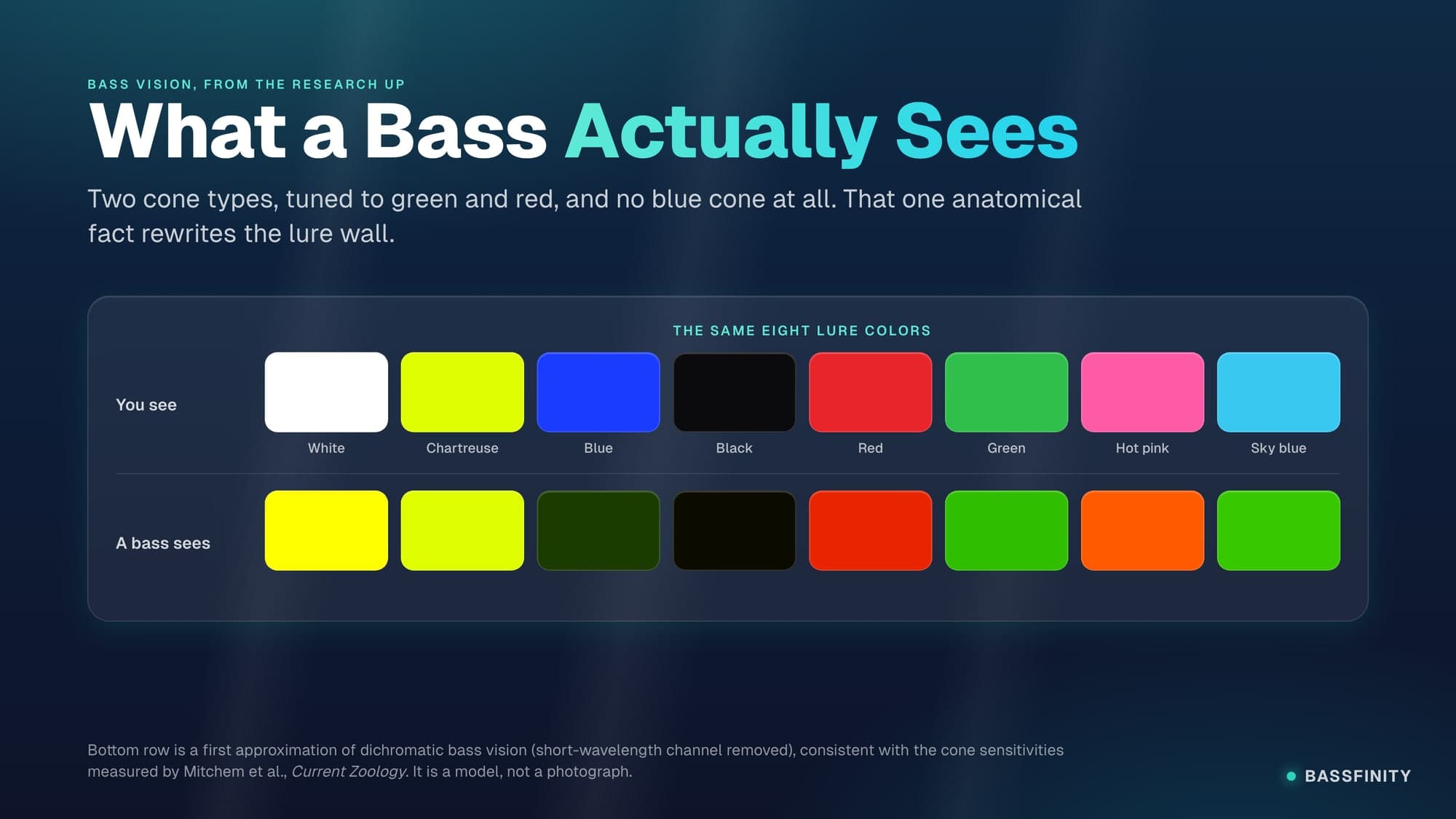
Bass see red, green, and some blue. You've seen the graphic. We'd seen it enough times that we went and found the paper it leans on.
Most of us inherited our color opinions. Somebody at the ramp swore by green pumpkin, so that's what's in the bag. A magazine said black-and-blue for muddy water twenty years ago and nobody has argued since. Chartreuse "because they can see it." Some of that holds up when you check it. Some of it doesn't. And the graphic that gets passed around every spring manages to get the important part right and the memorable part wrong.
So this is the long version. What's actually been measured inside a largemouth's eye, what the fish did when somebody asked them to pick a color, what water does to light before it ever gets to your bait, and what all that is worth when you're standing in front of the lure wall.
What's in the eye
The study is from 2019, in the journal Current Zoology. Mitchem, Stanis, Zhou, Loew, Epifanio and Fuller, working out of the University of Illinois, titled it "Seeing red: color vision in the largemouth bass," which tells you where it ends up. They took bass from Florida and from Illinois, pulled individual photoreceptor cells, and shone light through them to see which wavelengths each cell absorbed. The two populations came out the same.
Three kinds of cells:
- Single cones, peaking around 535 nm. That's green.
- Twin cones, peaking around 614 nm. Orange-red, and further into the red than our own long-wavelength cone, which peaks closer to 560.
- Rods at about 528 nm. Rods are for dim light and brightness. They don't do color.
What they didn't find was a blue cone. We have three cone types. A largemouth has two, both parked on the warm end of the spectrum. Most of what follows comes out of that one fact.
A caveat before we go further, because it matters. The cone work came from nine adult fish. The behavior trials below used juveniles, two tanks per color, and the authors mention that in a tank, one or two bold fish often did the choosing for everybody. It's a real study with real numbers. It isn't a big one. And it's largemouth only. Nobody has done this to a smallmouth, so when we get to smallmouth later we're guessing from a close cousin, and we'll say so.
What the fish did
Knowing what a cone absorbs tells you what the eye can register. It doesn't tell you what the fish does with it. So the Illinois group trained young bass to hit a colored target for food, then put a row of targets in front of them and counted. Red, green, blue, black, white, chartreuse.
With no scent on the targets, it shook out like this. Red-trained fish hit red about 85% of the time. Green-trained fish hit green about 72%. Then the researchers ran those two groups against a row of gray targets matched for brightness, and the fish still found their color. That's the test that shows they were seeing hue and not just light versus dark.
Blue was a different story. Blue-trained fish hit blue 48% of the time and black 39%. Black-trained fish went 71% black, 29% blue. Those two colors were running together.
White and chartreuse ran together too. Chartreuse-trained fish spread their strikes over chartreuse, white, and blue. The white-trained fish didn't show a preference the statistics could pick up at all. The authors had predicted this from their model. Take the blue out of white light and what's left is a bright yellow-green, which is what chartreuse already is.
So you get three groups. Red and green, which a bass recognizes. Blue and black, which it merges. White and chartreuse, which it also merges.
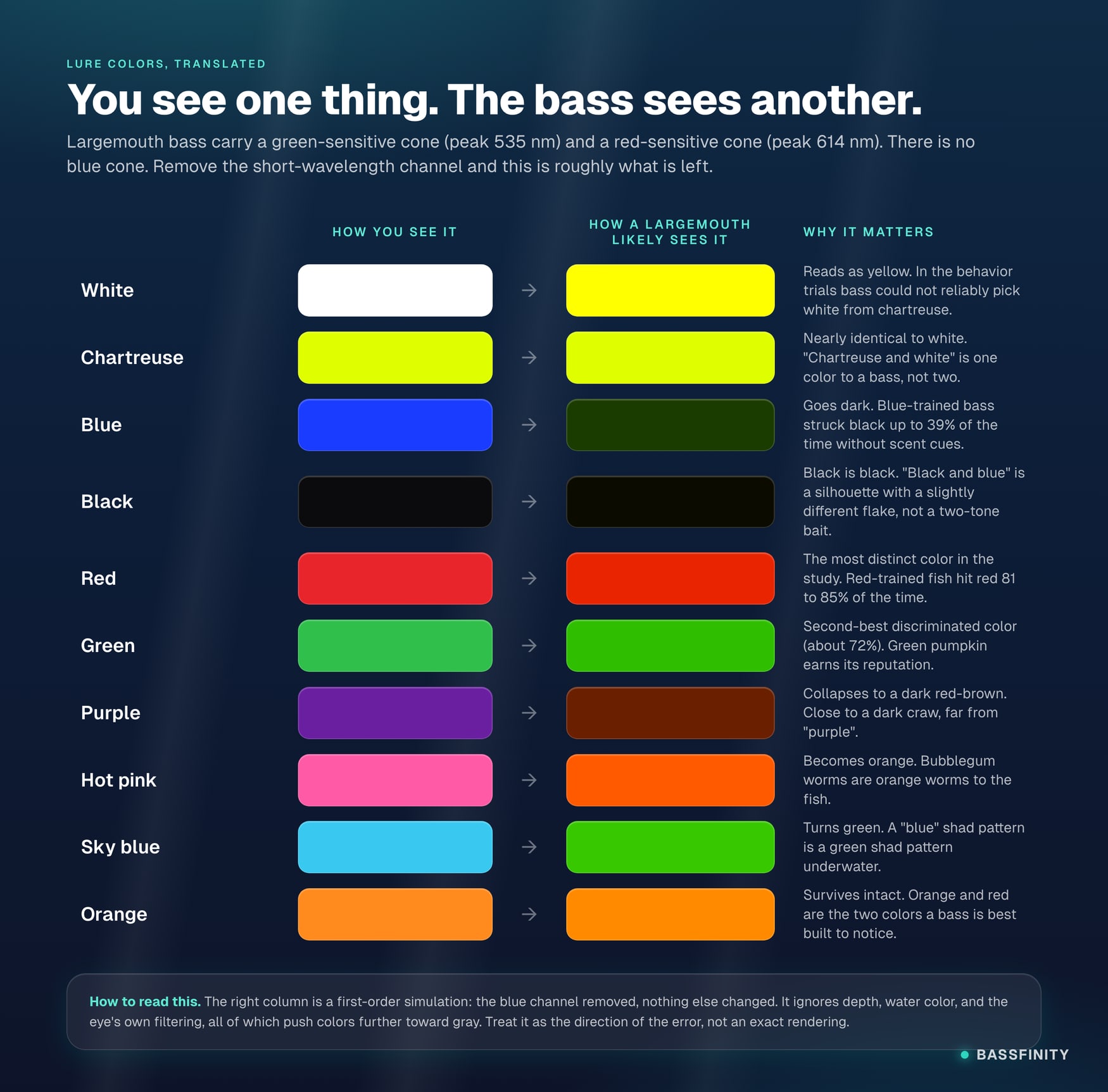
Some of these take a second. White comes out yellow. Purple ends up somewhere near a dark craw. A bubblegum worm is an orange worm. The blue-back shad pattern you like is a green-back shad pattern. The Illinois lab put out a little app a few years back that does this same translation, and that's where the idea for the chart came from. We rebuilt it with colors people actually buy.
About that "some blue"
This is the part we wanted to push on. The graphic says, in large type, that bass see red, green, and some blue. We couldn't find the measurement.
The anatomy says no blue cone. The behavior says blue-trained fish hit black nearly as often as blue. The only place blue gets a foothold is in the authors' own model, which predicted the fish should at least tell blue from black on brightness. The fish didn't. The authors' guess is that the lens or something else in the eye is filtering out short wavelengths before they reach the receptors, which the model didn't account for. So the one argument for "some blue" is an argument the real fish failed.
Where did it come from, then? Our best guess is the Color-C-Lector days in the eighties, when the whole conversation was about which colors penetrate water, not which colors a bass can distinguish. Blue light does go deepest in clear water. That part's true, and it's in the next section. But light reaching a depth and a fish seeing it as a distinct color are two different things, and the graphic runs them together.
If a bait's selling point is that it's blue, you're buying something the fish isn't. It's getting a dark bait. Whether the dark bait catches fish is a separate question, and the answer is often yes, for reasons that have nothing to do with blue.
Water gets there first
All of the above assumes the color makes it to the fish. Mostly it doesn't, not intact. Water soaks up light selectively, long wavelengths first. Red goes, then orange, then yellow. Green and blue hang on deepest in clear water. In stained water the dissolved stuff eats blue hard, so what survives shifts toward green and yellow, and the whole thing plays out over a few feet instead of a few tens of feet.
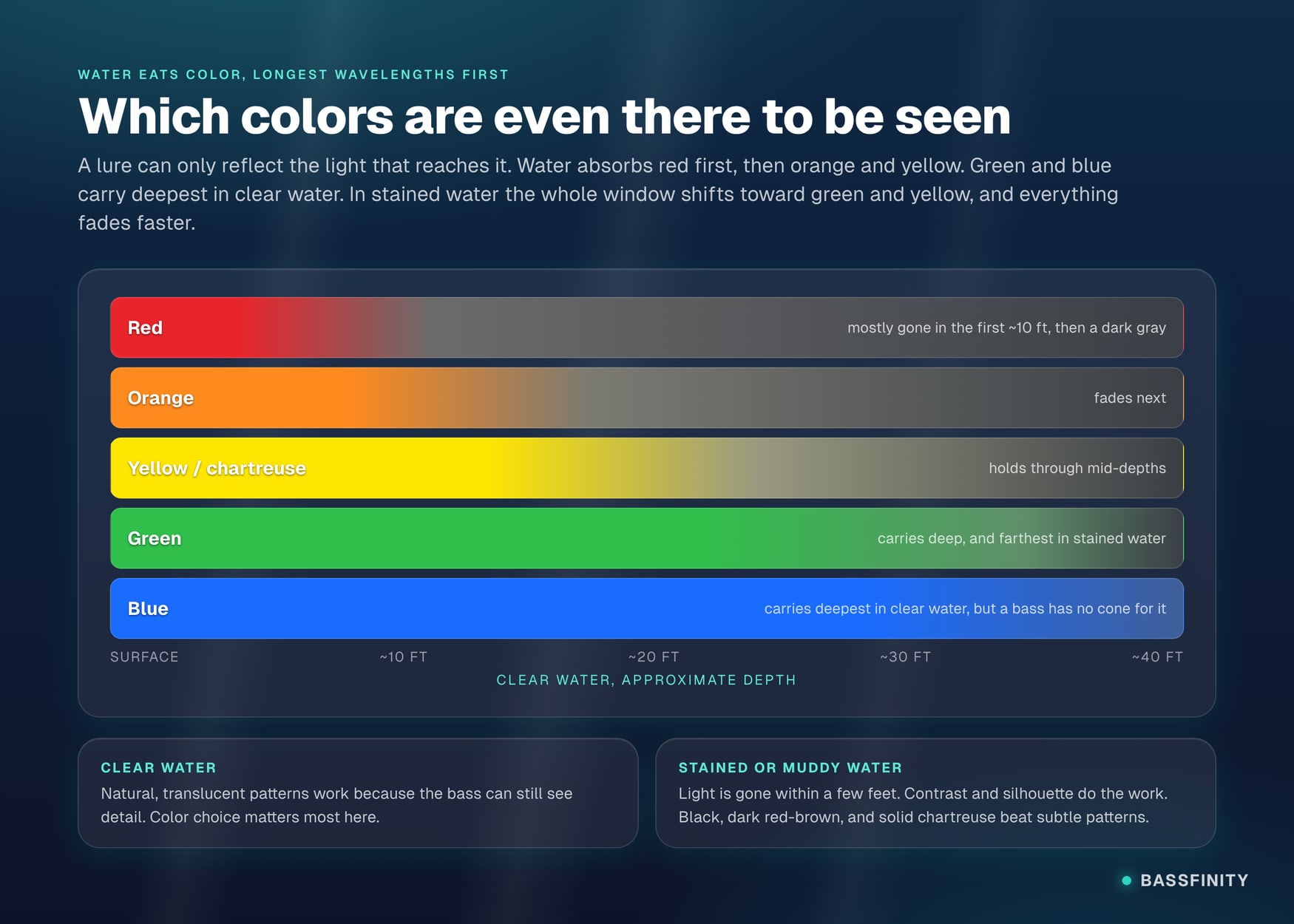
Here's where the biology and the physics stack up against you. The color a bass is best built to see, red, is the first one the water takes away. A red lipless crank in three feet of clear water in April is red to the fish, and the study says that's about the strongest color signal a bass can get. The same bait dragged across a twenty-foot ledge in July is a dark gray bait, because there's no red light down there to bounce off it. It might still get bit. It's getting bit as a shape.
And the color that goes deepest, blue, is the one the fish has no receptor for. "Blue goes deep" is true about the light and beside the point for the lure. Thirty feet down in clear water a bass is living in a dim green-blue room and looking at it with a green-and-red eye. That's greens and grays. Movement and contrast are most of what's left.
So why does chartreuse work?
Because it's bright. Not because it's chartreuse.
Chartreuse sits in the yellow-green band that lasts longest in stained water, it throws back a lot of whatever light is there, and to the fish it's a bright blob against a darker background. White does the same job for the same reason, and the study says the fish can't tell the two apart anyway. White-and-chartreuse is one color on the fish's side of the surface. The classic spinnerbait skirt is a high-contrast bait with some flash on it. That's the whole story.
Flip it around and you get black-and-blue. It's the stained-water jig because it's the darkest thing you can throw. The fish sees a solid dark shape with, maybe, a slightly different flake. The blue is for you. That doesn't make it a bad jig. A dark shape against a dim, backlit ceiling is exactly what an ambush predator is tuned for, same reason a black frog over a mat works when they're looking up.
Green pumpkin and watermelon and the craw colors earn their keep differently. Green was the second-best color in the trials, and a bass can see fine detail in the green-to-red range. In clear water, where that detail actually arrives, natural patterns give the fish something to look at that resembles what it eats. In muddy water they're wasted. The detail never gets there.
A box built around what the fish can use
Here's how we'd sort a tackle box with all this in mind. Starting points, not rules. Your lake gets a vote.
- Clear and shallow, bright sun. The one condition where color detail reaches the fish and the fish can resolve it. Natural stuff. Green pumpkin, watermelon, shad whites and pearls, craw browns and oranges. Red accents genuinely show here, so keep them on spring baits. Translucent plastics work because the fish can see through them the way it sees through a real shad.
- Clear and deep. Red and orange are gone. Greens, whites, silhouettes, and let action and profile carry it. A chartreuse or white accent is for contrast against the blue-green background, not for the color.
- Stained. The window is yellow-green and short. Solid chartreuse, solid white, dark solids. Bring one bright and one dark and let the fish tell you which one stands out better against that day's water. Vibration starts to matter as much as color.
- Muddy, or low light. Color is nearly irrelevant. Black, dark red-brown, or solid chartreuse, whichever contrasts hardest against what light is left. Bulk, vibration, slow it down. This is the dawn and dusk recipe too, and it's why a black buzzbait at last light doesn't need to be anything but black.
- Anywhere. Red, orange, and green are the three colors a bass is actually built to notice. If a bait has an accent, make it one of those. Blue and purple accents are paint you're paying for.
If that sounds like what the old guys at the ramp already do, yes. The research didn't overturn the folklore so much as explain which pieces of it were holding weight. Contrast and movement over exact shade. Natural when they can see, bold when they can't.
What this does to "match the hatch"
Back in May we argued in Match the Hatch that profile, size, and action come before color, and that local forage color is real. Bluegill in stained water run chartreuse and orange. Shad in clear water are pearl and silver. None of that changes. It gets a little sharper.
Run a bluegill through the chart. The orange belly survives. The olive back survives. That purple-blue shine on the gill plate doesn't; to a bass it's a dark patch. So a "bluegill" crankbait that nails the orange belly and the dark bars is matching the hatch as the bass sees it, and one that spent its paint budget on an iridescent blue flank is matching it as you see it. Guess which one the fish votes for.
Same with a spring craw. Vivid orange, nearly red sometimes, green and brown highlights. Every one of those is in the bass's best range, and in shallow spring water those colors actually reach the fish. We don't think that's a coincidence, and it's a decent explanation for why the red lipless and the orange-and-brown craw squarebill are spring baits and not summer baits. By July the fish are deeper, the red's gone, and that same bait is a dark gray thing with a rattle in it.
Smallmouth, honestly, we don't know. Nobody has measured their cones. They're close relatives with similar eyes, they live in clearer, cooler water where color detail travels further, and they eat a lot of crawfish. We'd bet on the same two-cone picture. We wouldn't bet on the numbers.
Knowing the water before you go
Most of the framework above hangs on two things you can know from the driveway: how clear the water is, and how much light is getting into it.
Clarity is the big one. The Intelligence Map has a water clarity layer built from satellite turbidity readings, so you can see which arms of a lake are running clear and which are stained before you decide which box goes in the truck. Turn the wind layer on with it. A day of onshore wind on a soft bank turns clear water stained by mid-afternoon, and your color plan has to turn with it.
TackleLens takes that same clarity reading plus the day's light and weather, the season, and your target species, and hands back a setup with the colors already matched to the water. It's basically doing the clear-stained-muddy sort above with live data instead of a guess from the ramp. If you want to know why it picked what it picked, ask the AI Fishing Guide. It'll pull from TackleLens and the map and walk you through it.
Light is the other half. Low sun bounces more light off the surface and lets less in, which is why dawn and dusk are silhouette time. SolunarBass gives you the feeding windows. If the best window of the day is also the lowest-light window, that tells you which half of the box to have open when it comes around.
The clarity layer, TackleLens, and the AI Guide are Pro. The wind layer and the SolunarBass forecasts are free, and they'll get you a long way on their own.
Go deeper
We put the field version of all this into a guide, with the clarity test, the three-role tackle box, and the forage translations in the order you'd use them on the water: Lure Color: What a Bass Can Actually See.
For the species basics this leans on, Largemouth Bass Fishing and Smallmouth Bass Fishing both already carry the clear-versus-stained color rule that the research now explains. Essential Gear: The Guide to Bait & Tackle is where to build the box. One bright, one dark, one natural in each lure family.
For where the fish are and how deep, which decides how much of this even applies, there's Bass Seasonal Patterns for the year and Fall Bass: Turnover and the Bait Migration for right now, when turnover can turn a clear lake the color of coffee for a week and your whole color plan with it. For the other thing that controls light under the surface, the weeds, see The Grass Is Greener on the Other Side.
On sourcing. The cone peaks, the training results, and the model predictions all come from Mitchem et al., "Seeing red: color vision in the largemouth bass," Current Zoology 65(1), 2019. It's open access and worth the twenty minutes. The depth and water-color physics is standard optics, approximate for any particular lake. The translation chart and the tackle framework are ours. Where we've extrapolated, mostly to smallmouth, we've tried to flag it.
Walleye anglers: we asked the same question about the walleye eye, and it's been measured too. Two cones, no blue, three orange-red cones for every green one, and a mirror behind the retina built for dusk. Unlike bass, though, nobody has run walleye through color trials. What that means for jigs, crankbaits, and glow at last light is in Walleye Lure Color: The Three-to-One Eye.
And when the water tells you something different from any chart, including ours, go with the water.
Tight lines.
- The Bassfinity Team