Walleye Lure Color: The Three-to-One Eye
A walleye has three orange-red cones for every green one, no blue cone, and a mirror behind the retina built for dusk. Here's what's been measured, what hasn't, and how to pick lure color by light and clarity.
In This Guide
Introduction
Walleye anglers have more color folklore than almost anyone. Orange. Chartreuse. Gold. Firetiger. Glow at dusk. Purple on cloudy days. Some of it rests on an actual measurement. Some of it doesn't. This guide sorts out which is which.
It's the walleye companion to Lure Color: What a Bass Can Actually See and the post What a Bass Actually Sees. Fair warning: the walleye eye has been studied in less detail than the bass eye, so there's more guesswork in here, and we've tried to flag every piece of it.
The short version. A walleye sees green and orange-red, sees no blue, has three orange-red cones for every green one, and carries a reflective layer that trades sharpness for sensitivity in dim light. Color matters to a walleye in bright, clear, shallow water. Everywhere else, brightness and contrast matter more.
What Is Inside a Walleye's Eye
The study everything here rests on is Burkhardt, Hassin, Levine and MacNichol, "Electrical responses and photopigments of twin cones in the retina of the walleye," in the Journal of Physiology, volume 309, 1980. They recorded from individual cone cells and measured their pigments directly.
- Twin cones carry a pigment peaking near 605 nm, orange-red. Both halves of each twin are identical, in pigment and in how they fire.
- Single cones carry a green pigment peaking near 533 nm.
- No blue-sensitive cones were found. That's the paper's own wording.
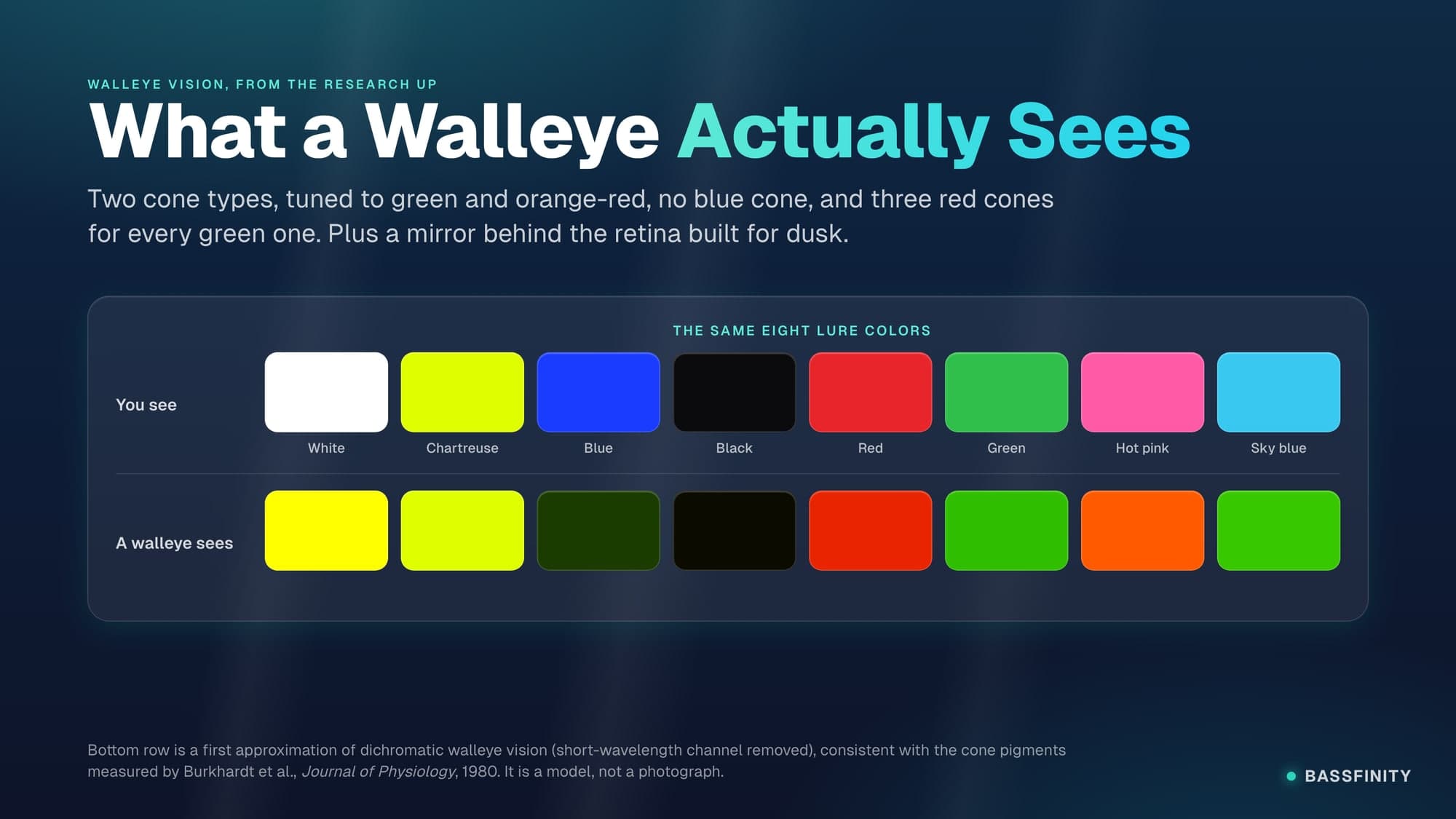
- Twin cones outnumber single cones about three to one in adults. The walleye retina leans toward the warm end of the spectrum in a way the bass retina doesn't.
The mirror. Behind the retina sits the tapetum lucidum, the reflective layer that gives walleye their name and their eyeshine. It bounces light that got past the photoreceptors back through them for a second try, which buys sensitivity in dim light and costs sharpness. Ali and Anctil compared walleye and sauger in 1977 and found the tapetum well developed across the whole sauger retina. In walleye it's mainly in the lower part of the retina, the part that looks up.
Seeing in the dark. In 2026, Keyler and colleagues published a study in PeerJ that measured dark-adapted walleye retinas with electroretinography. Peak sensitivity landed between 500 and 550 nm, blue-green to green. That's the light that survives deepest in clear water, and it's also the band most glow pigments emit in.
Pro Tips
- Three numbers to remember: 605 and 533 for the cones in daylight, 500 to 550 for the whole eye at night
- The tapetum is strongest in the part of the retina that looks up. A walleye is built to spot a silhouette above it in dim light
Important
- An older 1977 paper by Ali, Ryder and Anctil reported cone peaks near 560 and 630 nm. We go with Burkhardt's 533 and 605 because that work measured single cells and confirmed them electrically, but the disagreement is real and nobody has settled it
What Has Not Been Measured
The bass research had a second half. Fish were trained to strike colored targets, so the researchers could see which colors the fish actually told apart. Nobody has done that with walleye. There are no walleye discrimination trials, no confusion percentages, no direct test of whether a walleye can tell white from chartreuse or blue from black.
So when this guide says what a walleye "sees," it's one of three things:
- Measured. The cone pigments, the three-to-one ratio, the missing blue cone, the tapetum, the dark-adapted peak.
- Modeled. The translation chart in the next section, which takes the blue channel out of each lure color. It follows from the cones, but nobody has checked it against walleye behavior.
- Borrowed. The bass finding that two-cone fish merge white with chartreuse and blue with black. The walleye eye is laid out the same way, so we expect the same merges. Expecting isn't measuring.
None of this costs you anything on the water. The framework further down is built to work whether or not the borrowed parts turn out exactly right.
Important
- If you read a walleye color article quoting discrimination percentages, those numbers are from largemouth bass. No walleye version exists
Reading the Translation Chart
With two cones and no blue receptor, the simplest translation is to take the short-wavelength channel out of each color and look at what's left.
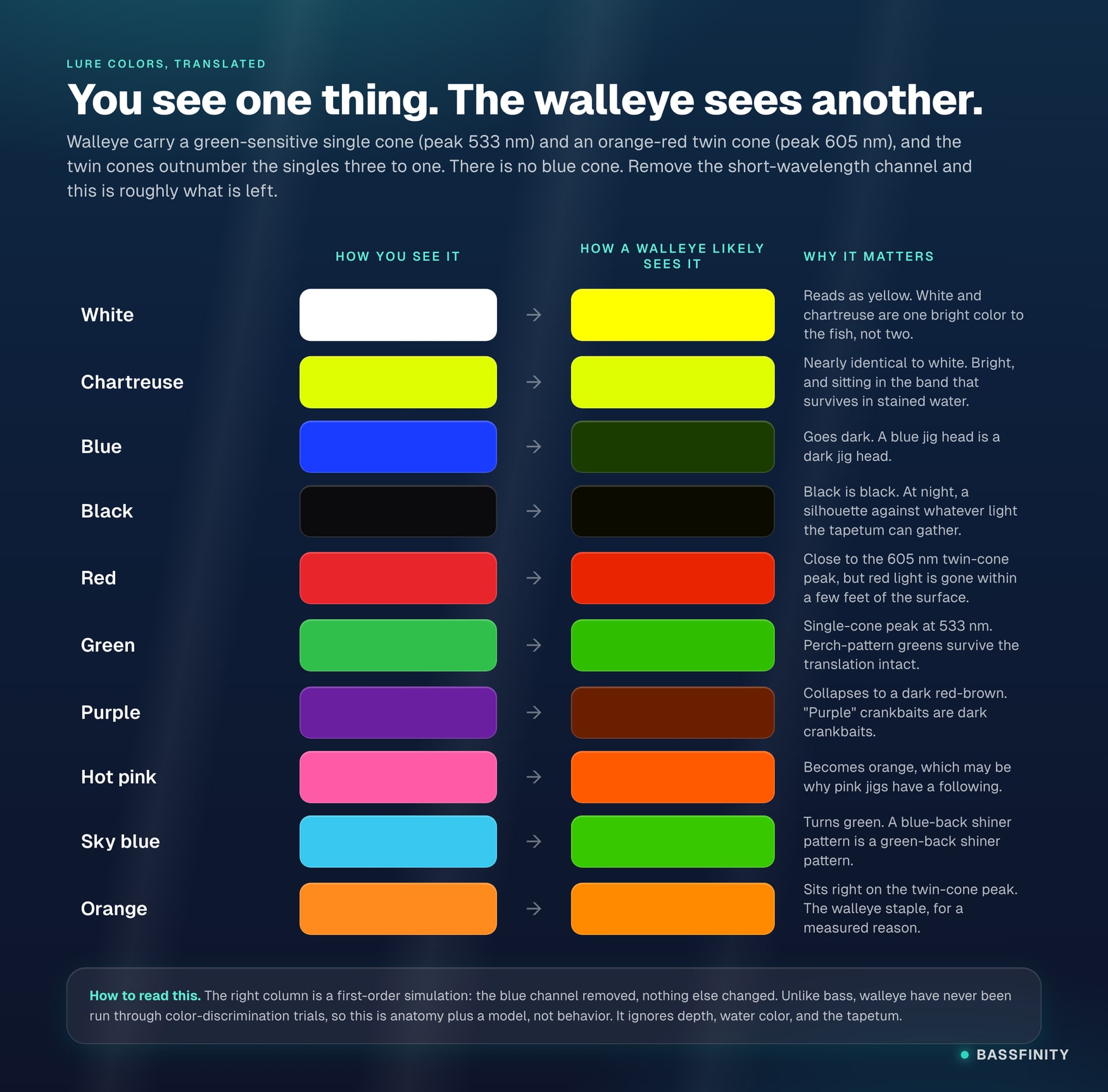
The translations that matter for a walleye box:
- Orange sits right on the twin-cone peak, and the walleye has three of those cones for every green one. The staple color has a measured reason behind it.
- Hot pink turns orange. Pink jig heads are orange jig heads to the fish, which may be why they have a following.
- White comes out yellow, which makes it the same bright color as chartreuse. A white-and-chartreuse jig is one bright color with a bit of contrast between light and lighter.
- Blue goes nearly black, purple goes dark red-brown. The famous cloudy-day purple crankbait is a dark crankbait. That's not a knock on it. A dark silhouette under a dim sky is exactly what an upward-looking, tapetum-equipped eye is built for.
- Sky blue turns green. Blue-back shiner patterns are green-back shiner patterns.
- Green comes through as it is, on the single-cone peak. Perch patterns keep their olive and their yellow.
Pro Tips
- Sort your jig heads by what they translate to: bright (white, chartreuse, glow), warm (orange, pink, red, gold), dark (blue, purple, black), natural (green, perch). Carry all four
Why Low Light Is the Walleye's Advantage
The tapetum does one job. It lets the walleye keep seeing after its prey has more or less gone blind. Dawn, dusk, overcast, stained water, and depth all shift the fight the walleye's way, and the Walleye Fishing Techniques and Fall Walleye guides are built around that timing. What it means for color is simpler than the folklore makes it.
Sensitivity costs sharpness. Light that has bounced off the tapetum is scattered, so a dark-adapted walleye sees a brighter but blurrier world. Fine color detail isn't available in that world. Brightness, size, and movement are. The lower the light, the less any particular color is doing and the more a bait's overall lightness or darkness against the background is doing.
The night eye peaks at 500 to 550 nm. That's the blue-green to green band, the light that gets deepest in clear water and the band most glow-in-the-dark pigments emit in. We haven't found a study that tests glow lures on walleye, so call this "consistent with" rather than "proven." But a bait that puts out its own light in the band the dark-adapted eye is most sensitive to is a sensible thing to throw at dusk.
Walleye look up. The tapetum is strongest in the lower retina, which views the water above the fish. A bait running above a walleye shows as a silhouette against the brighter surface. That's why a dark bait can outfish a bright one in the last hour of light. It's the stronger silhouette.
Keyler's group also modeled how deep a dark-adapted walleye could detect light at all. These are upper limits for the retina registering anything, not hunting depths, but the direction is worth knowing. In clear water (attenuation 0.3 per meter) the eye can register daylight to roughly 77 m and moonlight to about 11 m. In turbid water (1.2 per meter) that falls to about 13 m and 2 m. Stain shrinks a walleye's visual world far more than depth does.
Pro Tips
- In the last hour of light, think silhouette. A black or dark-purple bait running above the fish is often the strongest signal you can offer
- Glow pigments emit in the band the dark-adapted walleye eye is most sensitive to. Use them at dusk and in deep clear water, and charge them often
Important
- A tapetum-equipped eye is easy to overwhelm. Bright midday sun pushes walleye deep or into stain, and no lure color fixes that. Fish the wind, the shade, or the clock instead
Water Removes Color Before the Fish Sees It
The physics is the same for every species. A lure can only reflect the light that reaches it, and water removes the long wavelengths first. Red goes within the first several feet of clear water, then orange, then yellow. Green and blue carry deepest in clear water. In stained water the whole window shifts toward green and yellow and collapses to a few feet.
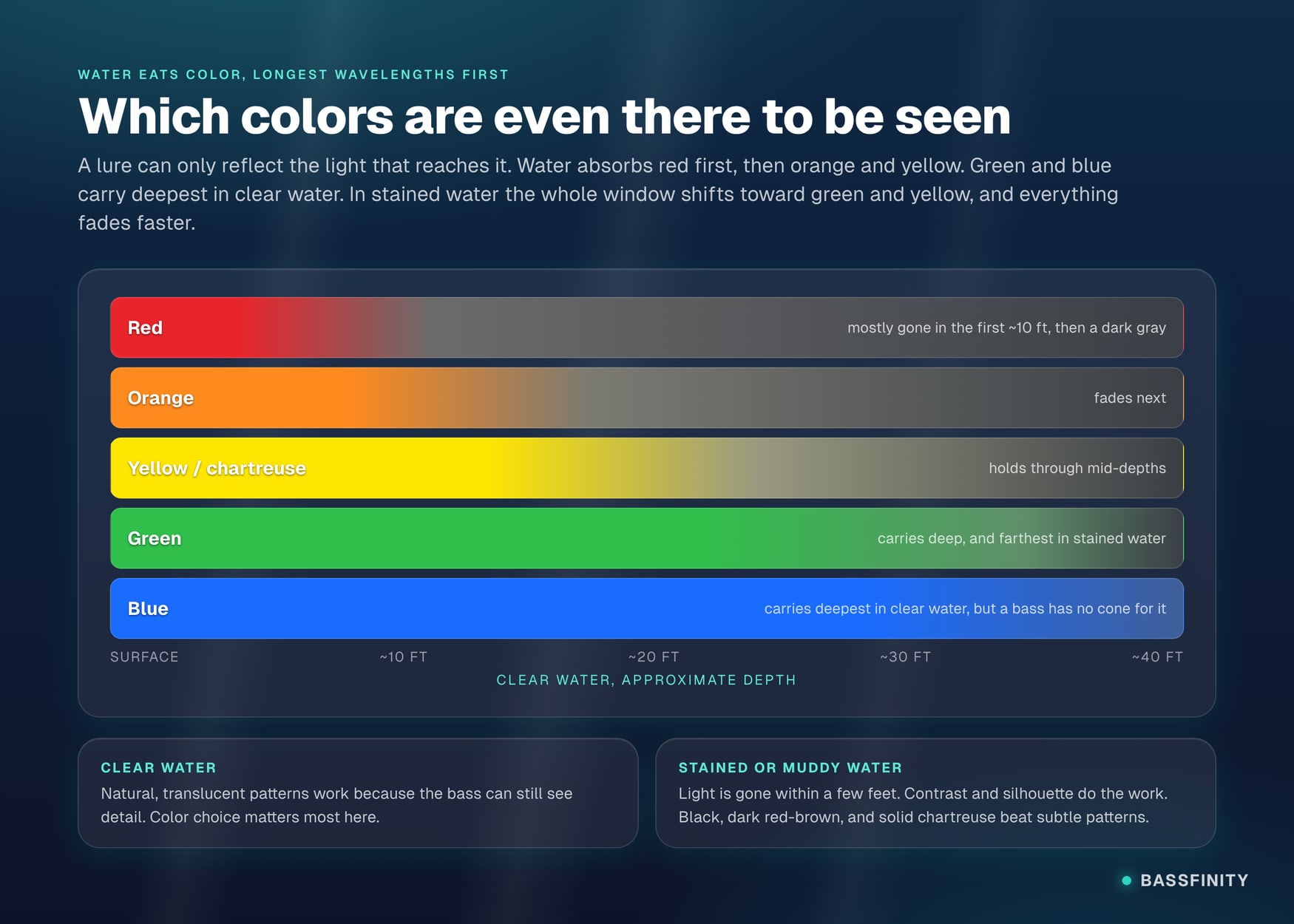
For walleye this cuts the wrong way. The color the eye is most heavily built for, orange-red, is the first the water removes. An orange jig in four feet of clear water at midday is orange to the fish. The same jig on a 25-foot reef at dusk is a gray-brown jig, seen by a dark-adapted eye that isn't resolving color anyway. It still catches walleye. It catches them as contrast and movement, not as orange.
So the deeper, darker, or dirtier the water, the more the walleye's color-weighted eye is beside the point and the more its light-gathering eye is in charge. Color decisions matter most in exactly the conditions walleye like least: bright, clear, and shallow.
Pro Tips
- Below the depth where you lose sight of a white jig, stop thinking in colors and start thinking in light-versus-dark and flash-versus-no-flash
A Color Framework by Light and Clarity
Starting points, not rules. The water and the fish get the final say.
- Bright, clear, shallow (the rare daytime bite). The only condition where color detail reaches a color-weighted eye. Natural perch and shiner patterns, gold and silver, with orange or red accents that genuinely show this shallow. Subtle beats loud here. The fall guide's advice to move toward natural finishes as autumn water clears is the same idea.
- Clear water, deep. Orange and red are gone. Flash (gold, silver, hammered blades), bright (white, chartreuse, glow), and contrast. A green or perch pattern keeps its color longest. Everything warm is a shade of gray.
- Stained water, daylight. The surviving window is yellow-green and short. Chartreuse, orange, firetiger, the classic walleye stain colors, work because they're bright in the one band that's still there, and because the tapetum-equipped eye is already good in dim light. Add vibration: blades, rattles, a bigger profile.
- Dusk, dawn, overcast. The walleye's home turf, and the point where color stops mattering much. One bright option (glow, white, chartreuse) and one dark option (black, dark purple, black-and-orange), and let the fish choose between the silhouette and the beacon. A bait above the fish is a silhouette. A bait at or below it is a beacon.
- Night. Contrast and vibration, full stop. Black or glow, slow, with a thump. Anything in between is wasted paint.
Notice there's no line here for "cloudy days" or "calm days." Those are light conditions, and the light decides whether color is even in play.
Pro Tips
- Make the first change a contrast change (bright to dark, or dark to bright), not a shade change (orange to pink)
- Carry glow and black in the same box. They're the two ends of the low-light scale, and the walleye will tell you which end the evening is on
Important
- Color is the last variable. Depth, speed, and timing put a walleye in front of the bait. Color only matters once it's there
Building the Walleye Box
Four roles per lure family covers the framework: bright, warm, dark, natural. Fill each with the bait whose action you trust.
- Jigs. Bright: chartreuse, white, glow. Warm: orange, pink (orange to the fish), red. Dark: black, purple. Natural: perch green, gold. A jig head is a small patch of color, so its job is mostly contrast against the bait and the bottom. A chartreuse head on a dark plastic is a contrast bait, not a chartreuse bait.
- Crankbaits and stickbaits. Natural: perch, shiner, and clown-style silver-and-orange for clear water. Bright: firetiger and chartreuse for stain. Dark: purple, black, or black-and-silver for dusk and night. Remember purple is a dark bait with a hint of red-brown, not a color.
- Spinner rigs and crawler harnesses. Blade flash and thump beat blade color. Gold and silver for clear water, hammered copper and chartreuse for stain, and a bead color that contrasts with the blade. The bait color is the live bait.
- Spoons and blade baits. Flash is the point. Gold, silver, and glow carry the role. A touch of orange on the belly is a real signal shallow and a free decoration deep.
The Walleye Fishing Equipment guide covers the rods, line, and terminal gear these ride on, and TackleLens will match the specific bait and color to the clarity, light, and season you're actually fishing.
Pro Tips
- Buy proven colors first (chartreuse, orange, black, glow, perch), then expand only into a role the box is thin on
Forage Through the Walleye's Eye
When you're matching forage, run the prey through the translation chart instead of the paint job.
- Yellow perch. Olive back, yellow flanks, dark vertical bars. All of it survives. Perch is the one pattern that reaches a walleye intact, which is a good reason it's the all-time default.
- Shiners and ciscoes. Silver and white read as bright, and the point of a shiner is flash and a pale belly. Blue backs become green backs. From below, the fish sees the dark back and light belly contrast.
- Crawfish and gobies. Brown, olive, and orange survive. A goby-brown jig with an orange thorax is matching the hatch as the walleye sees it.
What forage is around when, and at what depth, is in Walleye Seasonal Patterns. This section is just the color overlay for it.
Knowing the Light Before You Launch
The framework runs on two inputs, light and clarity, and you can know both ahead of time.
SolunarBass gives you the feeding windows and, with them, how much light each window will have. A dusk window and a 2 p.m. window call for different halves of the box. The Intelligence Map clarity layer, built from satellite turbidity, shows which basins and bays are stained before you pick a launch, and the wind layer tells you which bank will be stained by afternoon. TackleLens uses both to come back with a setup and colors already matched, and the AI Fishing Guide will explain the reasoning.
On the water, lower a white jig over the side and note where you lose it. That depth is roughly where color stops reaching the fish and the tapetum takes over.
Pro Tips
- Run the white-jig test again when the wind changes or you move basins. Walleye clarity is a local, hourly number
A Checklist, Held Loosely
- Put the bait in front of the fish first. Depth, speed, and timing before color.
- Translate the bait, not the package. Take the blue out and ask what's left. Pink is orange. Purple and blue are dark. White is chartreuse. Perch is perch.
- Orange is a measured strength of the walleye eye, and a shallow, bright-light color, because the water removes it first.
- As the light drops, switch from colors to contrast. One bright, one dark, and let the fish choose between beacon and silhouette.
- Glow belongs in the dusk and deep-clear slots, on a "consistent with the eye" basis, not a proven one.
- Check clarity and the light of each feeding window before launching, then run the white-jig test once you're out.
The measured parts here are the cones, the ratio, the missing blue, the tapetum, and the night-eye peak. The rest is ours, laid on top, and we've tried to label it. When a walleye disagrees with the chart, the walleye is right.
Important
- No behavioral color trials exist for walleye. Any article quoting what walleye "prefer" by percentage is quoting bass data or guessing
Tags
Related Guides
Walleye Fishing Techniques
Master the art of catching walleye with proven tactics for rivers, lakes, and reservoirs.
Fall Walleye: The Cold-Water Transition
Autumn walks a lake down through the temperature walleye prefer, then past it. Where fish reorganize after turnover, why bait profiles go up as the water cools, and how to fish the late-season window that produces the year's largest walleye.
Walleye Fishing Equipment
Complete guide to walleye tackle including rods, reels, line, and terminal gear.