Lure Color: What a Bass Can Actually See
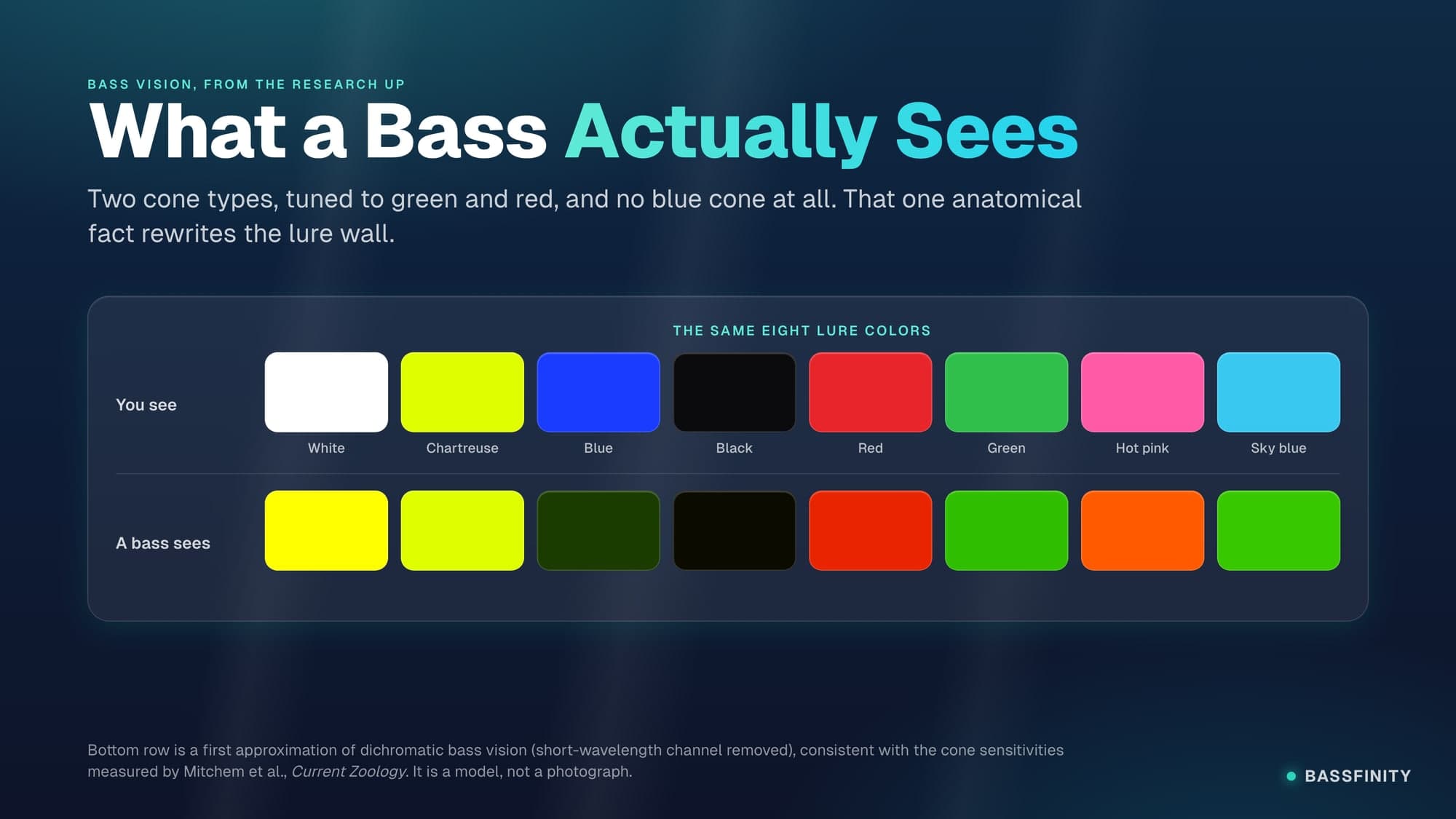
A largemouth has two cones, tuned to green and red, and nothing for blue. Here's how to translate the colors you own into what the fish gets, judge which colors even reach the depth you're fishing, and build a box around contrast instead of shade names.
In This Guide
Introduction
Walk down a tackle aisle and every color name on the wall was picked for you, not the fish. A largemouth has two kinds of cones, tuned to green and red, and nothing for blue. It's also looking through water that has already pulled part of the spectrum out before the light reaches your bait.
This is the on-the-water version of our post What a Bass Actually Sees, which has the longer argument and the sources. Here we stick to what you can use. What the eye can register, how to translate a color you already own into what the fish gets, how to tell which colors are even present at the depth you're fishing, and how to build a box around contrast instead of shade names.
One thing to hold onto the whole way through. Color comes last. Location, depth, profile, and action all come first. The best color in the world on a bait the fish never sees is worth nothing.
What Is Inside the Eye, and What Is Not
Everything here rests on one study: Mitchem, Stanis, Zhou, Loew, Epifanio and Fuller, "Seeing red: color vision in the largemouth bass," published in Current Zoology in 2019. They took largemouth from Florida and from Illinois and measured what individual photoreceptor cells absorbed. The two groups of fish matched.
- Single cones peak near 535 nm. Green.
- Twin cones peak near 614 nm. Orange-red, and further toward red than our own long cone at about 560.
- Rods peak near 528 nm. They handle brightness and dim light, not color.
They found no blue cone. We have three cone types. A largemouth has two, both on the warm side. The upshot is that two colors that differ mainly in how much blue they carry look about the same to the fish.
That's not the same as saying bass see in gray. Red and green are real, separate colors to a bass, and the behavior work in the next section shows the fish uses them. It's also not a measurement of smallmouth. There's a section on that further down.
Pro Tips
- Two numbers to remember: green and orange-red. Almost everything else here follows from them
- Nine adult fish went into the cone work. Solid in direction, approximate in detail
What the Fish Could Tell Apart
A cone measurement says what the eye can respond to. The same study then checked what the fish did with it. Young largemouth were trained to strike a colored target for food, then shown a row of targets in red, green, blue, black, white, and chartreuse, and scored on what they hit.
With no scent on the targets:
- Red-trained fish hit red about 85% of the time. Green-trained fish hit green about 72%. Both groups could also find their color in a row of grays matched for brightness, which shows they were going on hue and not just lightness.
- Blue-trained fish hit blue 48% of the time and black 39%. Black-trained fish went 71% black and 29% blue. Those two were running together.
- Chartreuse-trained fish spread their strikes over chartreuse, white, and blue. White-trained fish didn't show any preference the statistics could detect. The authors' model had called it ahead of time: white light minus its blue is a bright yellow-green, which is already chartreuse.
So, three groups. Red and green, which a bass recognizes. Blue and black, which it merges. White and chartreuse, which it also merges. Every color rule in this guide comes out of those three groups.
About "bass see some blue." It's on the infographics. We couldn't find a measurement behind it. There's no blue cone, and the trials show blue-trained fish striking black nearly as often as blue. The only place blue shows up is the authors' own model, which predicted bass should be able to split blue from black on brightness. The actual fish didn't. Treat blue as a dark color and you'll be closer to the truth.
Pro Tips
- If a bait's selling point is that it's blue or purple, the fish is getting a dark silhouette. Judge it as one
- Red and orange accents are the ones a bass is built to notice. Spend your accent money there
Important
- The trials used juveniles in two tanks per color, and the authors note one or two bold fish often did the choosing. Good direction, small numbers
Reading the Translation Chart
The simplest way to put the two-cone finding to work is to translate every color you own into the fish's version. The chart does that with one crude rule. Drop the blue channel, change nothing else.
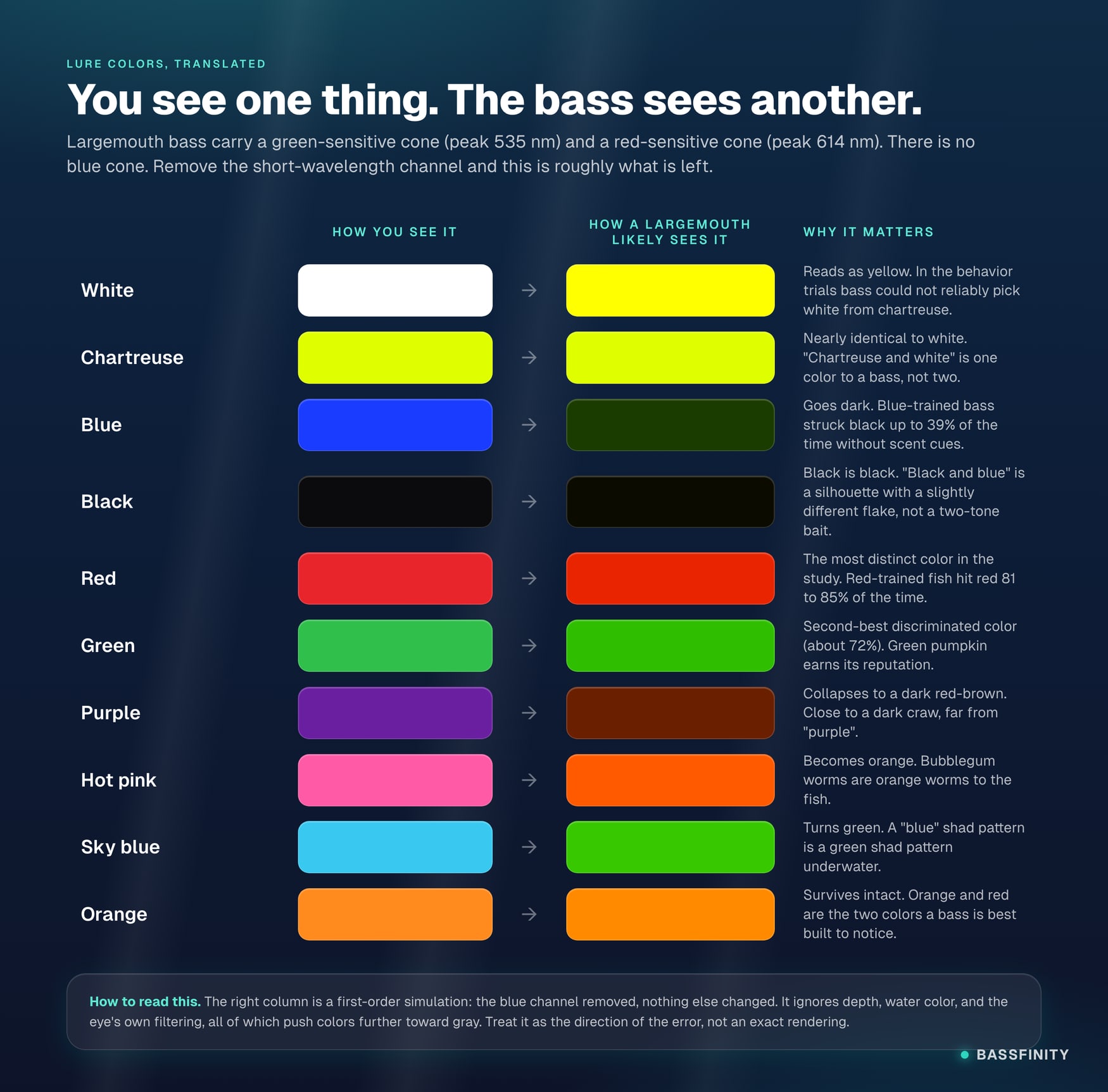
The ones that change decisions:
- White comes out yellow, which makes it the same color as chartreuse. A white-and-chartreuse skirt is one bright color with flash on it.
- Blue goes nearly black. Black-and-blue is a dark silhouette with a slightly different flake. Still a fine muddy-water jig, because of the silhouette.
- Purple ends up dark red-brown, which is close to a dark craw. Junebug and plum are craw-adjacent darks to the fish.
- Hot pink turns orange. Bubblegum is an orange worm, and orange is a color the bass is built to see. That might be why it works.
- Sky blue turns green. A blue-back shad is a green-back shad underwater.
- Red, orange, and green come through as they are. Those are the three worth paying for as colors.
For a color that isn't on the chart, ask what's left once the blue is gone. Anything with a lot of blue in it darkens. Anything built from red and green stays close to what you see.
Pro Tips
- Sort your plastics into three piles with the chart. Bright (white, chartreuse, bone), dark (black, blue, purple, junebug), natural (green pumpkin, watermelon, craw). Buy to fill the thin pile
- When two baits translate to the same color, keep the one with the better action and stop carrying both
Important
- The chart ignores depth and water color. A red that survives the translation still vanishes at fifteen feet. That's the next section
Water Removes Color Before the Fish Sees It
A lure can only reflect the light that reaches it, and water takes the long wavelengths first. Red goes, then orange, then yellow. In clear water green and blue carry deepest. Stained water adds dissolved organics that eat blue, so what survives shifts toward green and yellow, and the whole thing happens over a few feet instead of a few tens of feet.
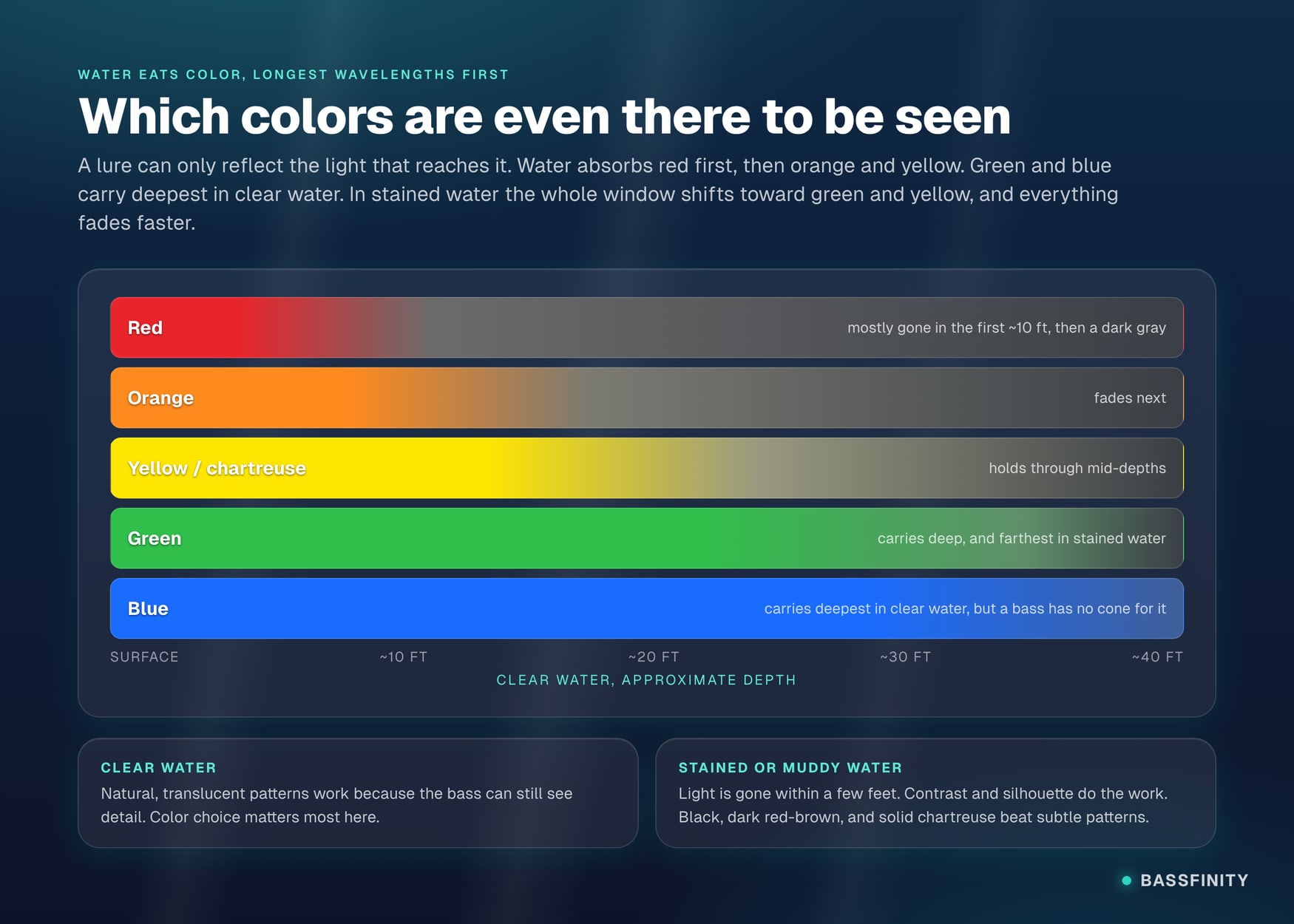
Stack that on the eye and you get the two facts that organize lure color:
- The color a bass sees best, red, is the first one the water removes. A red lipless crank in three feet of clear April water is red to the fish and about the strongest signal it can get. The same bait on a twenty-foot ledge is dark gray with a rattle.
- The color that goes deepest, blue, is the one the fish has no receptor for. "Blue goes deep" is true of the light and beside the point for the lure.
So the deeper and dirtier the water, the less color is doing and the more contrast, silhouette, vibration, and profile are doing. The framework below is really a slider, from "color matters" at the clear and shallow end to "color hardly matters" at the muddy or deep end.
Pro Tips
- Red and orange are shallow, bright-light colors. Spring baits more than summer baits
- Once you're below the depth where you lose sight of a white bait, assume the fish is seeing shape and movement, not shade
Judging Clarity and Light on the Water
The framework needs two inputs, water clarity and light. You can know both before you launch and check both in half a minute once you do.
Before you launch. The Intelligence Map has a water clarity layer built from satellite turbidity readings, so you can see which arms of a lake are running clear and which are stained before you pick a box. Turn the wind layer on with it. A day of onshore wind on a soft bank will have that water stained by mid-afternoon, and your color plan needs to change with it. TackleLens uses the same clarity reading plus the light, weather, season, and species to come back with a setup and colors already matched to the water, and the AI Fishing Guide will tell you why it picked what it picked.
On the water. The old test still works. Lower a white bait over the side and note the depth where you lose it. That's roughly where color detail stops reaching the fish. Below it you're fishing silhouettes.
- Clear: you can still see the bait several feet down. Color choice matters most here.
- Stained: gone within a couple of feet. The window is yellow-green and short.
- Muddy: gone almost at once. Color is close to irrelevant. Contrast and vibration carry it.
Light. Low sun bounces more off the surface and lets less in. Dawn, dusk, and heavy overcast nudge any water a step toward the stained column. SolunarBass tells you when the feeding windows fall. If the best one is at first light, have the dark half of the box open when it gets there.
Pro Tips
- Run the white-bait test again when you move arms of the lake or the wind comes up. Clarity is a local, hourly number
- Satellite clarity is a recent snapshot, not live. A storm since the last pass changes it
The Color Framework by Clarity and Depth
Starting points, not rules. The water gets a vote.
- Clear and shallow, bright sun. The one condition where color detail reaches the fish and the fish can resolve it. Natural stuff: green pumpkin, watermelon, shad whites and pearls, craw browns and oranges. Red accents genuinely show here, so keep them on spring baits. Translucent plastics work because the fish can see through them the way it sees through a real shad.
- Clear and deep. Red and orange are gone. Greens, whites, silhouettes, and let action and profile carry it. A white or chartreuse accent is there for contrast against the blue-green background, not for the color.
- Stained. The window is yellow-green and short. Solid chartreuse, solid white, dark solids. Carry one bright and one dark and let the fish tell you which one stands out better against that day's water. Vibration starts mattering as much as color, so think bladed jigs, Colorado blades, rattles.
- Muddy, or low light. Color is nearly irrelevant. Black, dark red-brown, or solid chartreuse, whichever contrasts hardest against what light is left. Bulk, vibration, slow it down. Same recipe at dawn and dusk. A black buzzbait at last light doesn't need to be anything but black.
- Anywhere. Red, orange, and green are the three colors a bass is actually built to notice. If a bait has an accent, make it one of those. Blue and purple accents are paint you're paying for.
If that sounds like what experienced anglers already do, it is. The research didn't overturn the folklore so much as explain which pieces were holding weight. Contrast and movement over exact shade. Natural when they can see, bold when they can't.
Pro Tips
- Make the first change of the day a contrast change (bright to dark or back), not a shade change (green pumpkin to watermelon)
- When a color "stops working" mid-day, check whether the light or the wind changed before you blame the color
Important
- Color is the last variable. If location, depth, and profile are wrong, no color fixes it. Confirm the fish are where you're fishing before you start cycling colors
Building the Box: One Bright, One Dark, One Natural
Three contrast roles per lure family covers nearly every clarity-and-light combination. Fill each role with the bait whose action you trust, and resist buying a fourth shade of the same role.
- Soft plastics (worms, stick baits, creature baits). Natural: green pumpkin or watermelon, with red flake if you like it. The flake really is visible shallow. Dark: black, junebug, or plum, all of which translate to dark silhouettes. Bright: white or bubblegum, keeping in mind that bubblegum is orange to the fish.
- Jigs and trailers. Natural: green pumpkin or brown with an orange or red trailer tip for the craw look. Dark: black-and-blue, fished as the silhouette it is. Bright: a white or white-and-chartreuse swim jig for stained water and shad.
- Crankbaits and lipless baits. Natural: shad and craw patterns for clear water. Dark: a black-back, dark-belly bait for muddy water or low light. Bright: chartreuse or firetiger for stain. Add a red lipless for shallow spring water specifically.
- Spinnerbaits and bladed jigs. White and white-and-chartreuse are the same bright bait with flash. Keep one. Add a black or black-and-red for night and mud. Once the water stains, blade flash matters more than skirt shade.
- Topwater. From below, the fish sees a silhouette against a bright ceiling. Belly color is what it sees. Bone or white belly most days, black for low light, and spend nothing on the back.
The Bait & Tackle guide covers the lure families themselves and a starter kit. This section is the color overlay for it.
Pro Tips
- Buy proven colors first (green pumpkin, black-and-blue, white, chartreuse) and only then expand into specialty patterns
- Topwater: look at the belly, not the back. That's the only side the fish sees
Matching Local Forage Through the Bass's Eye
Profile, size, and action come before color when matching the hatch. When color does come up, run the forage through the translation chart instead of the paint job.
- Bluegill. The orange belly and the olive back survive. The purple-blue shine on the gill plate doesn't. To a bass it's a dark patch. A bluegill pattern that gets the orange belly and the dark vertical bars right is matching the hatch as the bass sees it. One that spent its budget on an iridescent blue flank is matching it as you see it.
- Shad. Pearl, silver, and white all translate to bright, which is the point of a shad: flash and a pale belly. Blue and purple backs become dark backs. Green backs stay green.
- Crawfish. Spring-molt craws run vivid orange to nearly red with green and brown highlights. Every one of those sits in the bass's best range, and in shallow spring water they actually reach the fish. That's a good reason craw-pattern squarebills and red lipless baits are spring staples. By midsummer the fish are deeper and the red's gone.
For the forage calendar itself, the Bass Seasonal Patterns guide and our post Match the Hatch cover what's being eaten when.
Pro Tips
- Flip a few rocks at the ramp and note the craw color. Then pick the craw pattern whose red, orange, and brown match, and ignore its blue highlights
Smallmouth: Extrapolation, Not Measurement
Nobody has run the Illinois protocol on smallmouth. They're close relatives of largemouth with similar eye structure, so the two-cone, no-blue picture almost certainly holds in outline. We wouldn't bet on the exact peak wavelengths or the exact numbers from the trials.
What changes in practice is mostly the water, not the eye. Smallmouth favor clearer, cooler lakes and rivers, where color detail travels further and the "clear water" line of the framework applies more of the time. They're also heavily keyed on crawfish, which puts the surviving colors, green, brown, orange, and red, at the center of a smallmouth box. Green pumpkin tubes, brown and orange Ned rigs, and craw-pattern jerkbaits are the usual suspects, and they line up with the research even though the research wasn't done on them.
The Smallmouth Bass Fishing guide has the techniques. Lay the clear-water line of the framework above on top of it.
Important
- Everything in this section is inferred from largemouth data. If a smallmouth study turns up with different numbers, it wins
A Checklist, Held Loosely
- Confirm location, depth, and profile before touching color. Color is the last variable.
- Translate the bait, not the package. Take the blue out and ask what's left. White is chartreuse, blue is black, pink is orange, purple is dark craw.
- Run the white-bait depth test every time you move or the wind changes. Below that depth, fish silhouettes.
- Carry three roles per lure family, bright, dark, and natural, and let the fish choose between contrast levels before you start cycling shades.
- Save red and orange for shallow, bright water, where they're both present and visible.
- In mud or low light, stop thinking about color. Black or solid chartreuse, bulk, vibration, slower.
- Check clarity before you launch on the Intelligence Map, and let TackleLens do the clear-stained-muddy sort with live data.
When the water disagrees with the chart, go with the water.
Important
- The cone peaks and the trial results are measured. The translation chart and the framework are our synthesis on top of them. Hold the second kind more loosely than the first
Tags
Related Guides
Essential Gear: The Guide to Bait & Tackle
A comprehensive guide to fishing lures, baits, and terminal tackle. Learn about hardbaits, softbaits, jigs, spinnerbaits, and everything you need to build your tackle box.
Largemouth Bass Fishing
Master America's most popular gamefish with proven techniques for targeting largemouth bass in any season.
Smallmouth Bass Fishing
Target the bronze bruiser with techniques designed for rivers, lakes, and clear water environments.