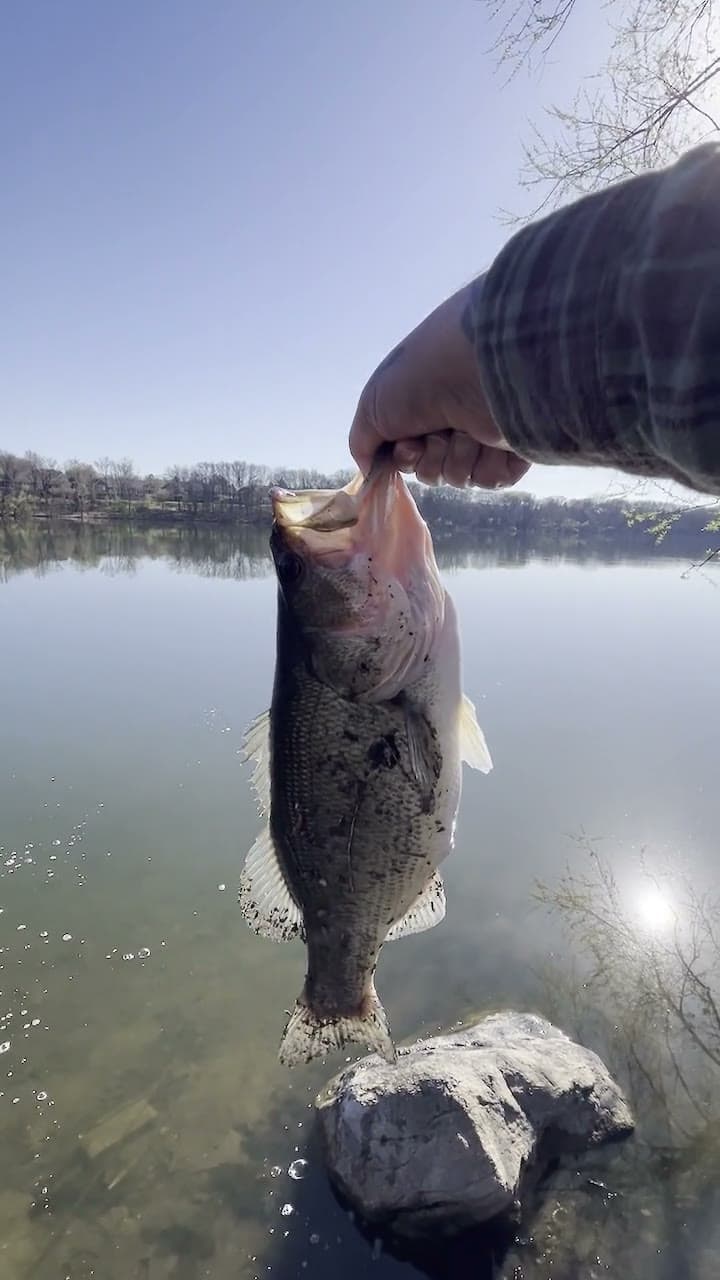
Fall is not one season. It is seven of them, running on different schedules, in the same lake, and the fish have not agreed on which one they are in.
The autumnal equinox lands today, which makes this the traditional moment to publish something about the fall feeding frenzy. We are going to do the opposite, because the more we looked at the temperature data the less that single story held up.
So we wrote five new guides - one each for smallmouth, northern pike, musky, crappie and bluegill - and they disagree with each other on purpose.
Fall means something different to every fish in your lake
Every species has a temperature band it prefers. Those bands are further apart than most anglers assume, and that single fact reorganises the whole season.
Working from the Great Lakes Fishery Commission's data compilation, the rough ladder looks like this:
- Northern pike prefer about 66-68°F, and actively avoid water above 73°F.
- Walleye sit near 69-74°F.
- Smallmouth in fall select around 70-73°F.
- Musky grow best at 75-80°F.
- Bluegill are up at roughly 86°F.
Now walk a lake down through autumn and watch what that does. Cooling water moves toward the pike's preferred band, through the walleye's and the smallmouth's, and steadily away from the bluegill's. A single September cold front is good news for one of those fish and bad news for another.
That is the part the frenzy story cannot survive. Fish are not all feeding heavily in fall because conditions are improving for all of them. Conditions are improving for some and deteriorating for others, and the fish are responding accordingly.
The bluegill case is the clearest. Depending on which study you take, bluegill growth stops somewhere between 55°F and 68°F. On the higher end, that means bluegill can be done growing while the lake is still in the 60s - in much of the country, late September. By the time bass anglers are calling it peak fall, the bluegill season is already over.
The five new guides
Each one is built around what autumn actually does to that species, rather than around a generic seasonal template:
- Fall Smallmouth: The Preference Shift - the preference itself moves with the season. The same fish selects 54-55°F in winter and 86°F in summer. Fall is the one window where lab preference and where the fish actually live finally agree.
- Fall Pike: Cooling Into the Preferred Band - the one species where the folklore holds up. Summer above 73°F is genuinely uncomfortable for pike; autumn fixes it. Also why the best pike fishing arrives earlier than most people fish for it.
- Fall Musky: The Warmer Esocid - musky and pike get the same advice and should not. They are roughly nine degrees apart, which means the musky's good window closes first, and explains why the late-fall trophy season is slow by nature.
- Fall Crappie: The Suspended Transition - crappie preference moves about three degrees across the entire year. They are not chasing temperature at all. They are following forage and light, and you should search accordingly.
- Fall Bluegill: Cooling Away From Optimum - the counter-case. Fish them early, downsize as it cools, and do not expect a frenzy that is not coming.
Two you may have missed
These complete a set. If you fish bass or walleye, the other two fall guides are already up:
- Fall Bass: Turnover and the Bait Migration - the largemouth side, and why the frenzy framing is half wrong.
- Fall Walleye: The Cold-Water Transition - where walleye reorganise after turnover, and the late window that produces the year's largest fish.
That is every species we cover, each with its own fall. The full set lives in the guides library.
Where the numbers come from, and how hard to lean on them
The temperature figures throughout these guides come from Wismer and Christie's Temperature Relationships of Great Lakes Fishes: A Data Compilation (Great Lakes Fish. Comm. Spec. Pub. 87-3, 1987), which pulls together laboratory and field thermal data for 116 species.
We went back to the source document rather than repeating numbers from other fishing articles, and that turned out to matter. The compilation is candid about its own limits: the column most of these values sit in mixes two different measurements, and field values carry uncontrolled error from competition, predation, water quality and food availability.
You will see that reflected in the guides. Where the data is tight - the pike numbers cluster hard in the high 60s across lab and field, adult and juvenile - we say so. Where it scatters, like the musky figures, we say that too, and lean on the comparison rather than on any single number. Where two studies disagree by thirteen degrees, as they do for the bluegill growth floor, we print both.
None of it is a schedule your lake has agreed to follow. Carry a thermometer, use it in more than one spot, and keep your own log. One autumn of your own numbers beats any general guide, including ours.
Reader Exclusive: 25% Off Your First Month
If you want the rest of the toolkit while you work through the new guides, we are running a discount for readers to mark the start of the season.
Use code FALL2026 at checkout for 25% off your first month of Bassfinity Pro. That includes SolunarBass AI Bite Scores, TackleLens gear recommendations, BassLens AI species ID, the Intelligence Map, and everything else in the Pro toolkit.
This code expires Tuesday, September 29, 2026 - one week from today. New Pro subscriptions only.
Claim your 25% discount with code FALL2026 →
Tight lines, and remember that the fish in your lake are not all having the same autumn.
— The Bassfinity Team