Weeds make oxygen. Oxygen means fish. So fish the thickest, greenest mat you can find. It gets repeated so often it has stopped being questioned — and it is not wrong, exactly. It is just not the whole story, and treating it as gospel is a good way to spend an August afternoon working the wrong grass.
This post is an attempt to slow that down. What is actually growing on a given stretch of shoreline? What does the water chemistry literature actually say? And where does that leave an angler trying to raise a hookup ratio instead of just a bite count?
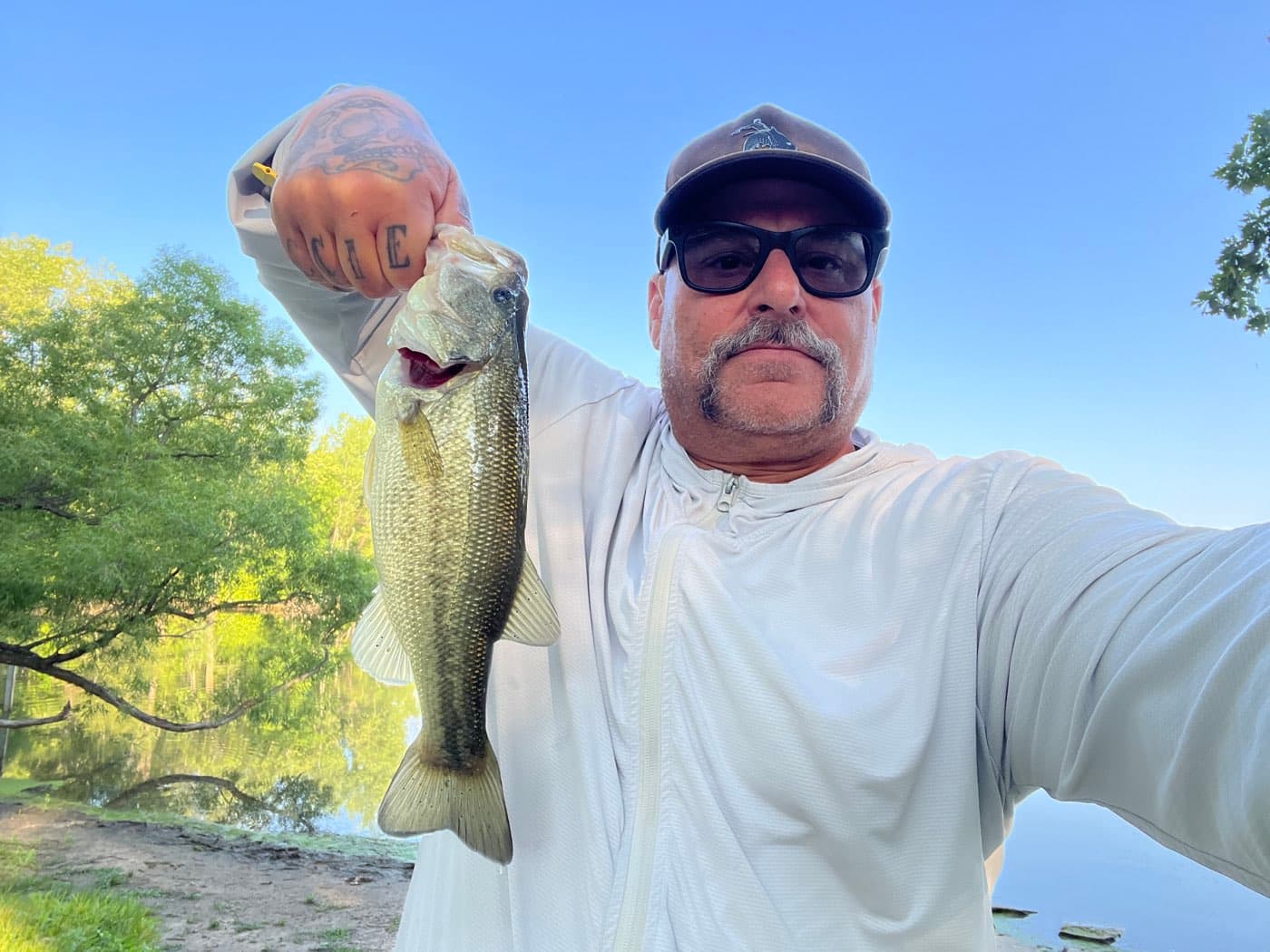
Everything below came off one riprap bank on a river backwater — slab rock, a gravel path, a dock down the shoreline, and a bass caught within casting distance of the samples. No boat, no electronics, no side-imaging of a deep weed line. Just what a bank angler can pick up by hand and pull off a lure. Treat the plant IDs as field guesses rather than lab results, for reasons that will make sense in a minute.
The oxygen story is real, but it is not simple
The reason vegetation gets credit for holding fish is legitimate. Submerged plants photosynthesize, and photosynthesis releases dissolved oxygen into the water column during daylight. That part checks out, and it is a big reason vegetated water tends to be more biologically productive than bare bottom.
Where the folklore oversimplifies is in treating "vegetation" as a single condition instead of a gradient. The cleanest number we have on this comes from Miranda and Hodges, writing in Hydrobiologia in 2000, who measured summer dissolved oxygen against vegetation coverage across ten shallow bays of a eutrophic reservoir. Mean DO ran 5.8 to 9.0 mg/L in open water at least 20 meters off the vegetation, 0.8 to 8.1 mg/L at the vegetation-water edge, and 0.5 to 7.7 mg/L inside dense vegetation. Oxygen was inversely related to how much of the bay the plants covered.
Read those ranges carefully, because the honest version is messier than the headline. It is not true that the edge reliably beats the interior — those two ranges overlap almost completely. What the data supports is a gradient: open water is consistently the best-oxygenated, and the more completely plants cover the water, the lower the oxygen runs. Worth noting the study conditions too. Those bays averaged between 0.6 and 1.3 meters deep in a nutrient-rich reservoir, which is about the most extreme case you could pick. A deep, clear lake will not behave this dramatically.
Then there is the day-night flip, which the folklore ignores entirely. At night plants stop producing oxygen and start consuming it through respiration, same as the fish around them. A dense stand that is an oxygen source at 2 p.m. can be an oxygen sink by 5 a.m.
The practical read: density matters as much as presence. Track the transition — the outside edge, the inside pocket, the point where sparse cover thickens — rather than assuming the darkest green patch is automatically the best water.
What this does and does not change about mats
We published a piece last month, Through the Thick of It, arguing that matted summer grass is the best real estate on the lake and that green mats produce oxygen where the fish are sitting. Some of that needs qualifying, so let's do it plainly rather than quietly.
What survives: the shade is real, the thermal refuge is real, and the forage concentration is real. Those are the load-bearing reasons bass live under a canopy in July and August, and none of them are in dispute. The green-versus-brown rule survives too — decaying vegetation consumes oxygen, so a dying mat really is worse than a living one.
What does not survive is the idea that the interior of a dense mat is an oxygen-rich place. Measured against open water, it is the opposite. So the fish under there are not being drawn in by superior oxygen; they are accepting mediocre oxygen in exchange for shade, temperature, and food. That is still a trade a bass will happily make on a 90-degree day. It just means the canopy's value is the shade and the buffet, not the chemistry — and it explains why the underside and the edges of a mat tend to fish better than its dead center.
What is actually on the line
Before you can read a weed bed, it helps to know what is growing in it, because different plants create different structure and different presentations work through them differently. Here is what came off this bank, with the confidence level attached to each — which turned out to be the most useful part of the exercise.
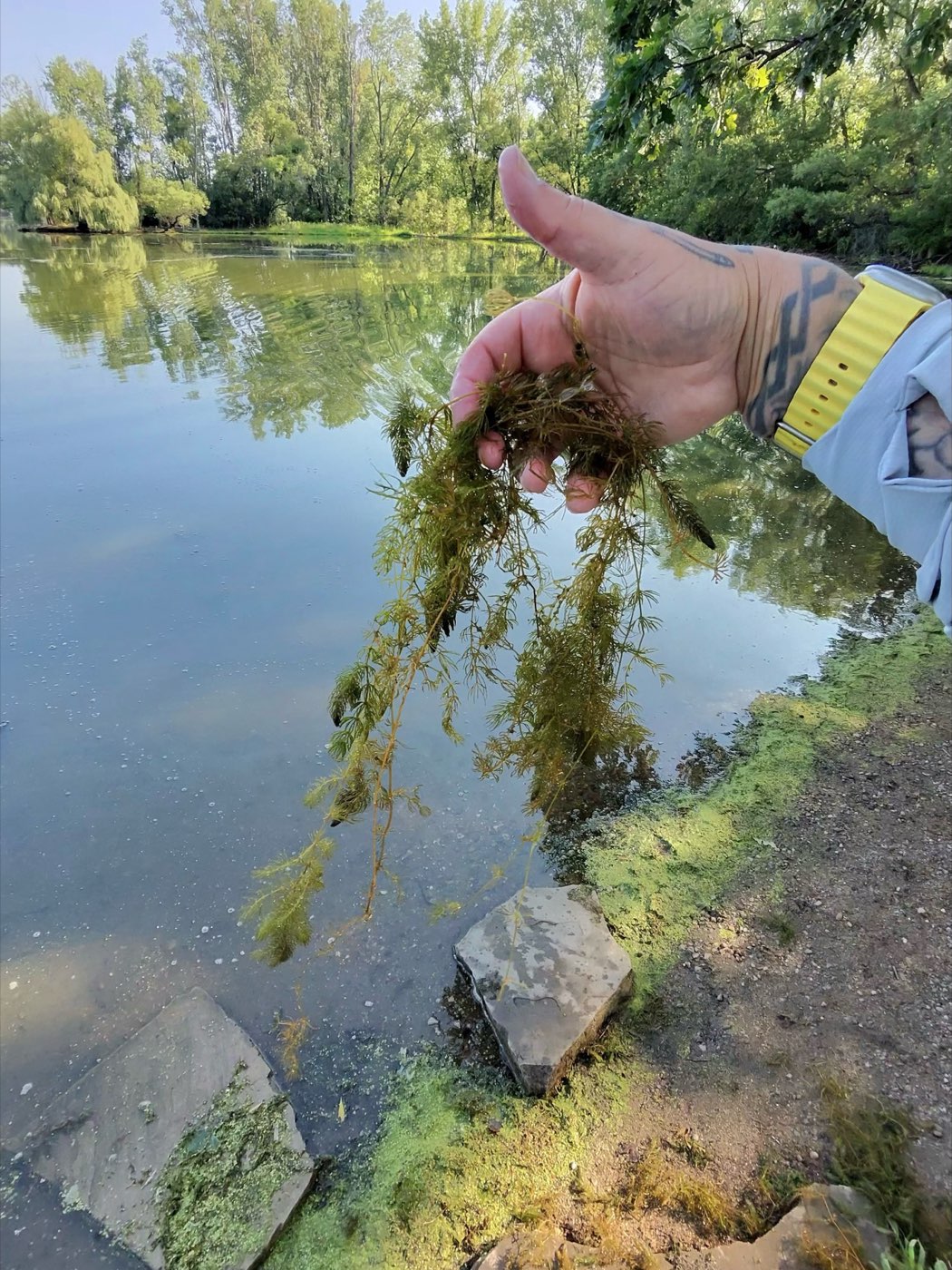
Feathery, whorled, and limp out of water. Soft, fern-like leaflets that collapse against the stem almost immediately. This is consistent with a milfoil, and there is a real test that separates it from the plant it gets confused with: milfoil leaflets branch off a single central midline like a feather, while coontail leaflets fork off each other. Count them, too. Eurasian watermilfoil carries 12 or more leaflet pairs per leaf; northern watermilfoil runs 5 to 10 and stays rigid when you pull it out. Limp plus a high leaflet count points Eurasian.
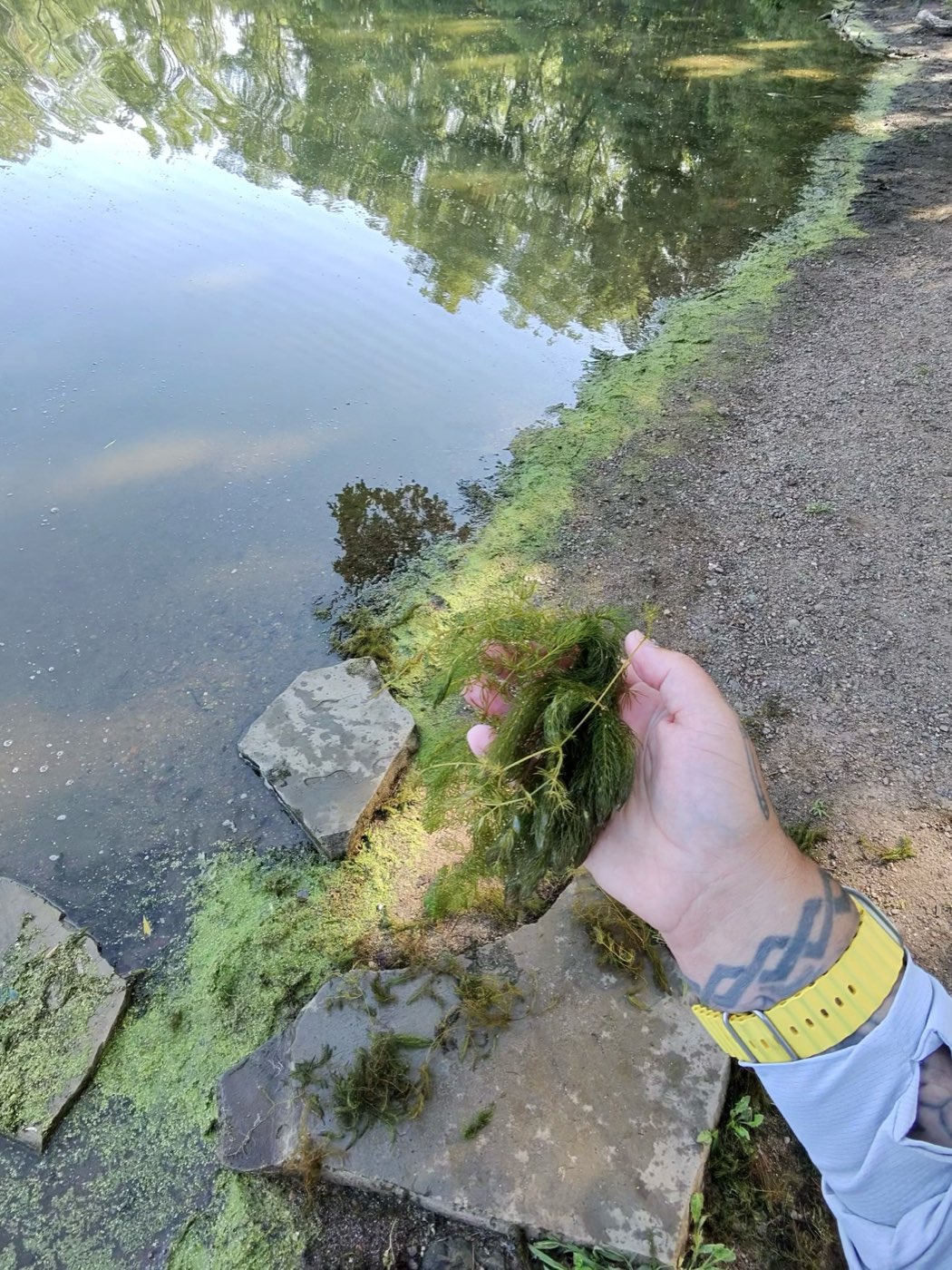
Bushy, dense, holding its shape. Coontail is the obvious candidate here: rough or spiny to the touch, forked rather than feathery, thickening toward the tips like a bottle brush. It has no true root system, so it anchors loosely or drifts free, and it stays rigid out of water instead of going limp. That said, all of that is a hypothesis from a photo and a handful. The crush-and-smell test and a look at the leaf margins would confirm it in about ten seconds on the bank.
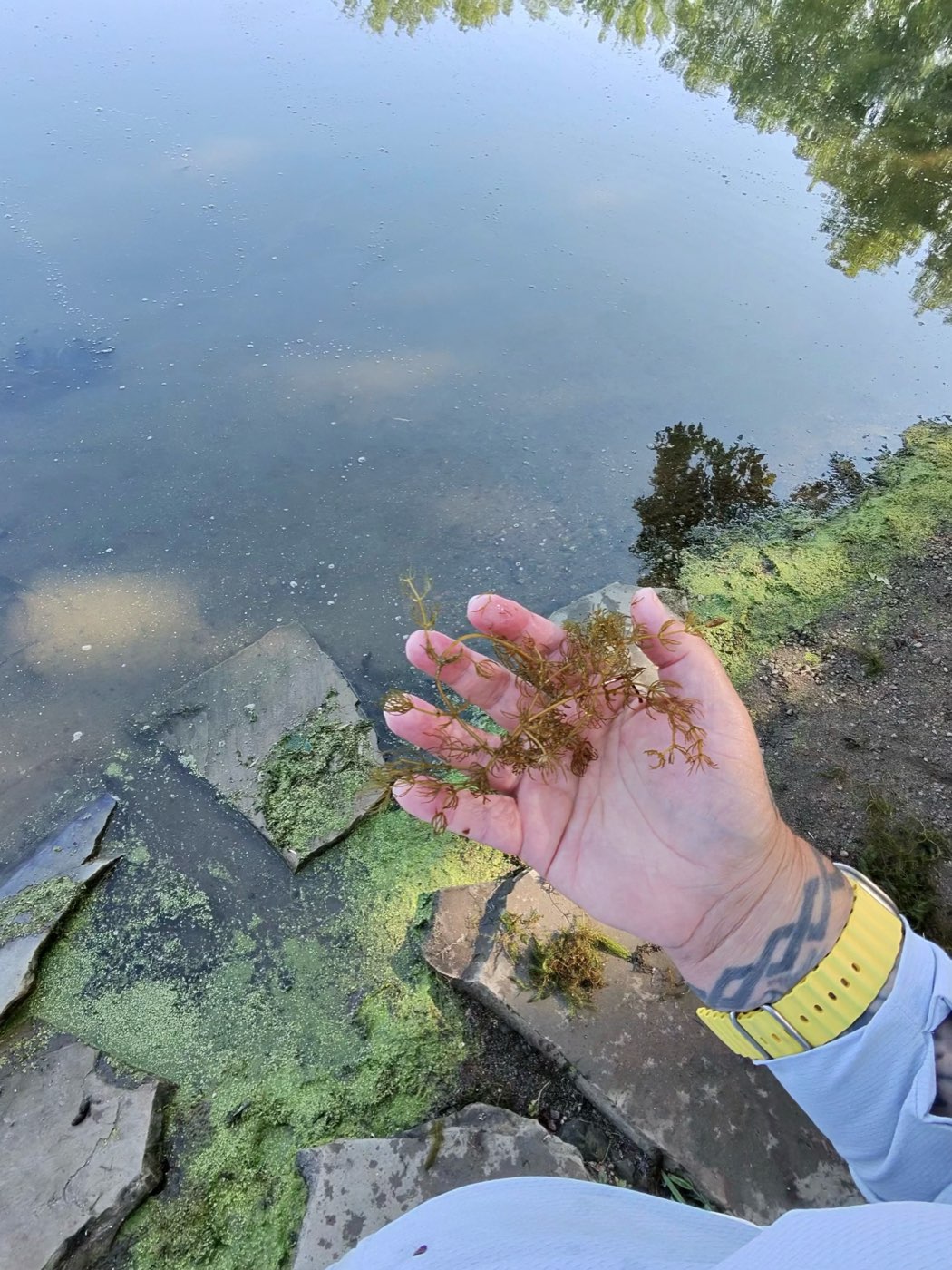
Thread-fine, whorled, reddish-brown. This one resisted a call. The whorled arrangement and forked segments lean coontail, especially a sprig that has been out of the water long enough to discolor. But the branching pattern and those small seed-pod-like structures along the stem would also fit sago pondweed or another narrow-leaf pondweed in mid-to-late summer. Two credible answers and no way to choose between them from what is in the picture.
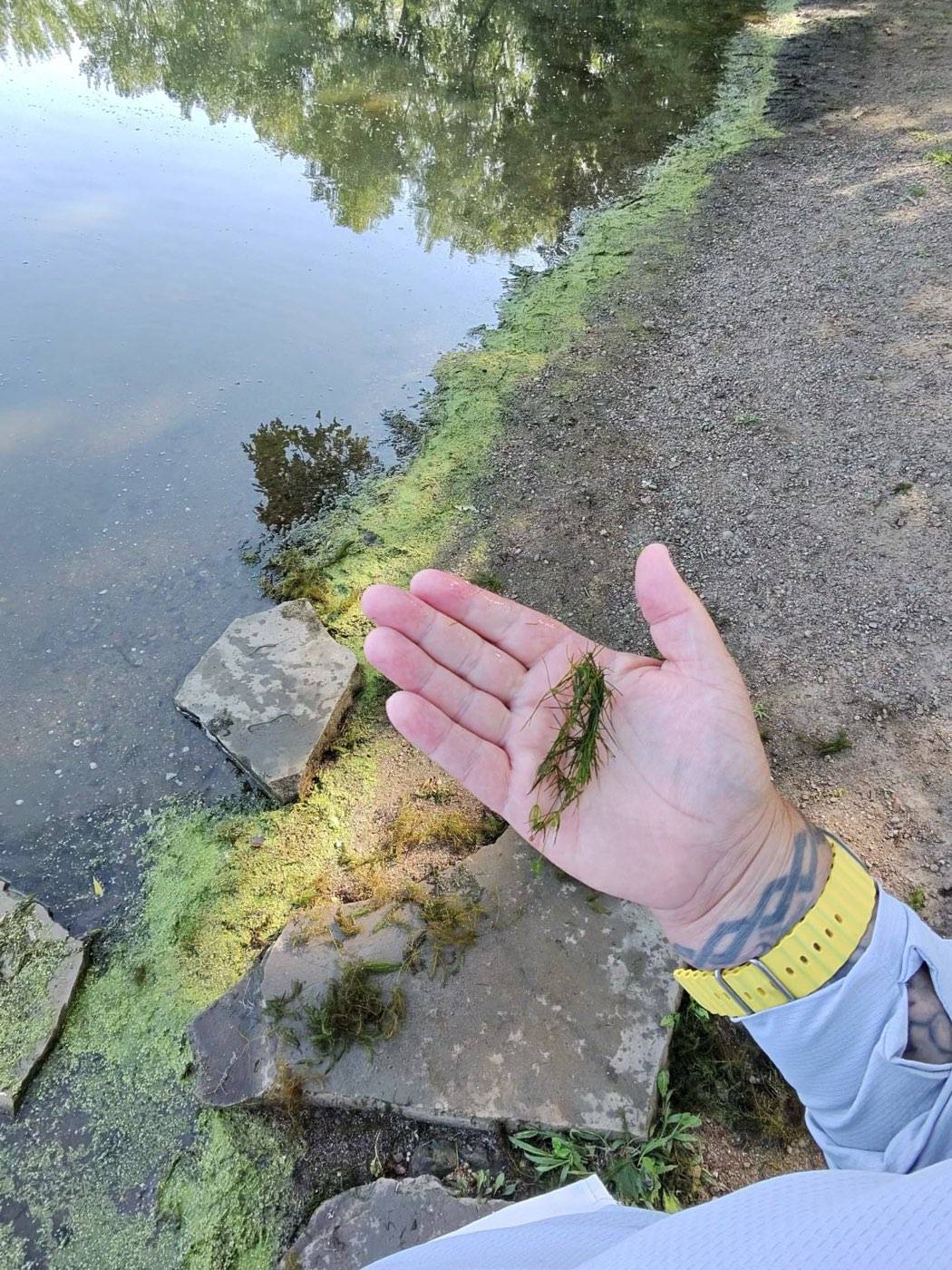
Narrow leaves along a branching stem. The instinct here is to call it wild celery, or tape grass — it reads as ribbon-like at a glance. The identification key rules that out. Wild celery grows as unbranched blades rising from a basal rosette at the bottom, with a pale stripe down the center of each leaf and no stem leaves at all. What is in this palm is a branching stem with narrow leaves attached along its length, bunched densest toward the tips. That is a naiad, commonly called bushy pondweed. It is a small distinction with a real consequence, because naiad and wild celery grow in different places and fish differently.
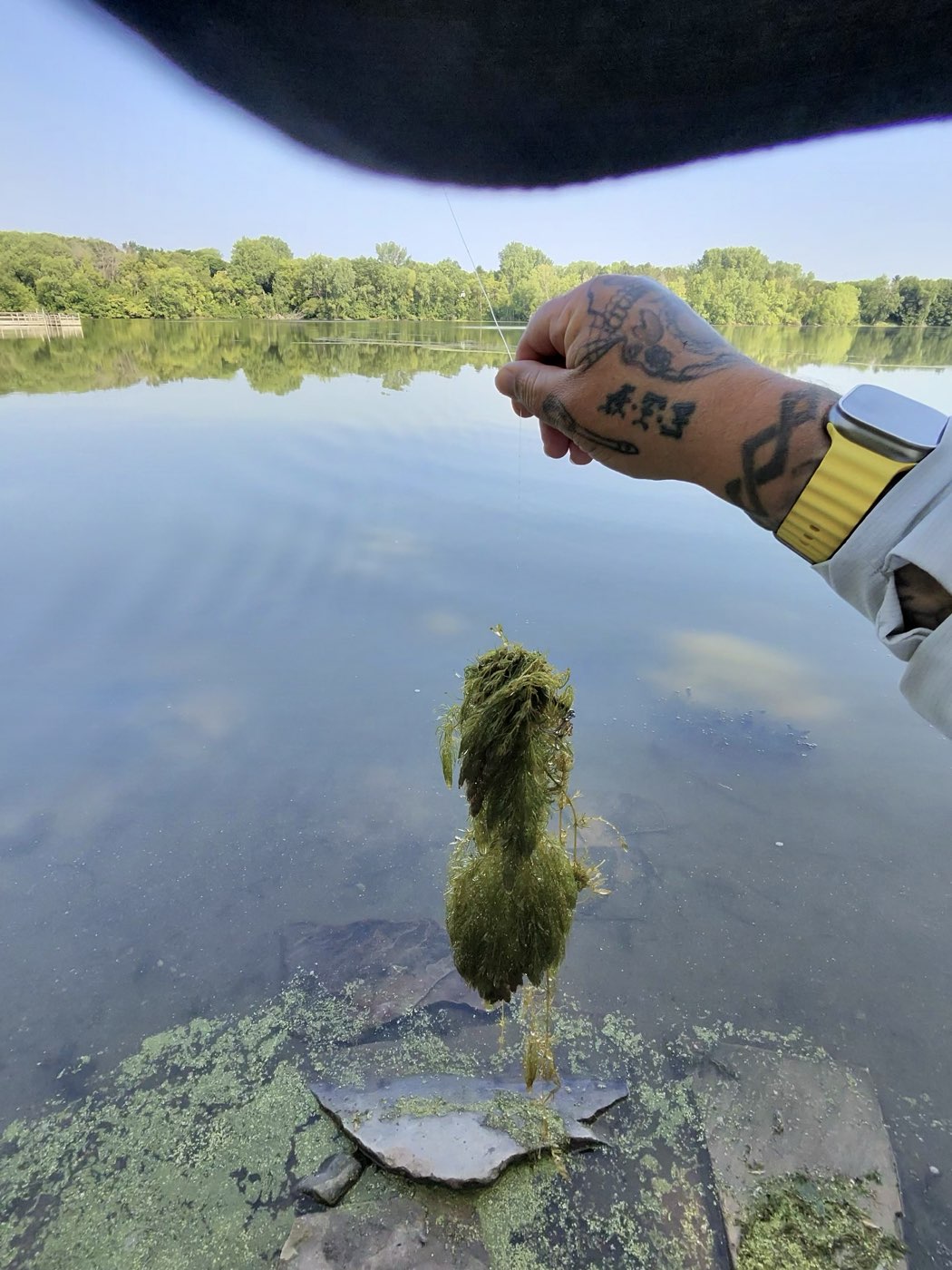
And this one is not a sample at all. It is a wad of material wrapped around the line on the retrieve, compressed and mixed. You cannot see leaf arrangement, you cannot see the stem, and you cannot tell how many species are in there. Plenty of anglers would still call it — "coontail" is the reflex — and that reflex is exactly the problem. Species confusion is common even in the aquatic plant management literature, where coontail, bushy pondweed, and Chara get mixed up constantly. The hand tests exist precisely because eyeballing a clump is not reliable.
That last point matters more than any single ID above. If "the fish are on milfoil today" turns out to actually be coontail, the pattern is not wrong because milfoil does not matter. It is wrong because the underlying data point was never verified.
The green stuff that is not a weed at all
Look at the rocks in any of those photos. The bright green coating the riprap and drifting in sheets along the waterline is filamentous algae, and it is the single most abundant plant material on this bank — yet it does not belong in a discussion of weed beds at all.
The distinction is worth internalizing. Rooted submersed plants create vertical structure: stems, canopies, edges, pockets, and the invertebrate habitat that feeds everything upward. Filamentous algae creates none of that. It is a mat or a film, it holds far less invertebrate life than rooted vegetation, and from an angling standpoint its main contribution is fouling your bait on every third cast.
It also inverts the oxygen story. Heavy surface algae blocks atmospheric exchange, and on warm, still, cloudy nights respiration can pull dissolved oxygen down hard enough to kill fish. A shoreline furred with algae is telling you something about nutrient load — it is not telling you there is good habitat under it.
"Ambush predator" is doing more work than it should
The second piece of folklore worth pressure-testing is the image of a bass sitting motionless inside a clump of grass, waiting. It is a useful mental picture, but the tracking observations complicate it. Anglers who have followed individual fish with transmitters — John Hope's work is the most-cited example — report that bass move almost constantly during active feeding periods, patrolling back and forth along cover edges and breaklines. The stillness happens when they are inactive and resting.
Worth being precise about the sourcing: this comes from angler-conducted tracking reported in the fishing press, not from a controlled peer-reviewed study, so hold it more loosely than the oxygen numbers above. But it is consistent with what underwater observers describe, and it has a practical consequence. Anglers who park on one spot and keep getting bit are not necessarily catching one stationary fish repeatedly. They are often intercepting a school cruising the same edge on a loop, which looks identical from the bank.
That distinction changes where the effort goes. If bass patrol edges rather than waiting inside cover, the outside seam — especially where it kinks around a point, dips into a pocket, or meets a hard-bottom transition like the base of riprap — is a higher-percentage target than the visually thickest interior.
Matching the presentation to what is actually there
None of this is useful unless it changes what goes on the end of the line. A rough framework built off density and plant type rather than "it is green, throw a frog":
- Sparse, scattered growth — naiad, thin pondweed, isolated coontail sprigs. Water moves through easily and light penetrates well, so moving baits work: a swim jig, a lipless crank, a spinnerbait on a stop-start retrieve, fished through and around without constant fouling.
- Moderate cover along an edge. Usually the highest-percentage zone, for the edge-patrolling reason above. From the bank this means walking the shoreline and casting parallel to the seam rather than straight out over it — a jig or Texas-rigged worm dragged along the edge covers far more productive water per cast than one thrown perpendicular.
- Dense mats. Reduced light and lower daytime oxygen at the interior mean fewer fish are buried deep inside than are sitting on top of, under, or right at the edge of the canopy. A weedless frog or a punched heavy Texas rig targets fish using the canopy for shade — see Through the Thick of It for the full technique.
- Filamentous algae. Not a target. Fish the clean water, hard bottom, or rooted vegetation near it, and pick a bait that sheds strands.
A checklist, held loosely
- Confirm the plant before building a pattern on it. The hand test — limp or rigid, forked or feather-midline, spiny or smooth, where the leaves attach — takes ten seconds and prevents chasing the wrong signal.
- Fish the edges and transitions first, not the visually thickest patch. That is where moving, actively feeding fish are more likely to be.
- Treat density as a dial, not a switch. Sparse and moderate cover often outperform the densest stands, especially on oxygen and light.
- Learn to tell filamentous algae from rooted vegetation. They look similar from ten feet away and mean completely different things.
- Re-check any pattern carried over from a different lake, a different species of plant, or a different point in the season. What held on milfoil in June does not automatically transfer to coontail in August.
- When a pattern keeps working, ask what is actually driving it before assuming it will repeat. Cover type, edge geometry, forage, and light are usually tangled together, and isolating which one matters is the difference between a repeatable pattern and a lucky afternoon.
We put the field-test version of all of this into a guide — the hand tests, the density framework, and how to tell algae from vegetation, in the order you would actually use them on the water: Reading Summer Vegetation.
The grass being greener on the other side is sometimes literally true. Sometimes it is an angler's own confidence talking. Worth checking which one it is before making the long cast.
Tight lines.
— The Bassfinity Team