Reading Summer Vegetation
Identify what's actually growing on your lake, read vegetation density as a gradient instead of a switch, and tell rooted plants from filamentous algae - then match your presentation to what you find.
In This Guide
Introduction
"Find the grass, find the bass" is good advice that stops one step too early. By midsummer most productive water has vegetation in it somewhere, so the useful questions are the next ones: which plant is this, how thick is it, and does that change where the fish sit?
This guide covers the field skills for answering those on the water. How to identify the four submersed plants you'll actually encounter using a hand test rather than a guess. How to read density as a gradient instead of a switch. How to tell rooted vegetation from filamentous algae, which look alike from a distance and mean opposite things. And how to match your presentation to what you find - from a boat or from the bank.
It pairs with Through the Thick of It, which covers the specific technique for fishing matted canopy once you've found it.
Density Matters More Than Presence
The folklore says vegetation produces oxygen, oxygen holds fish, so fish the thickest green you can find. The first half is true. The conclusion doesn't follow.
Miranda and Hodges measured summer dissolved oxygen against vegetation coverage across ten shallow bays of a eutrophic reservoir (Hydrobiologia, 2000). Mean DO ran 5.8-9.0 mg/L in open water at least 20 m off the vegetation, 0.8-8.1 mg/L at the vegetation edge, and 0.5-7.7 mg/L inside dense vegetation. Oxygen was inversely related to how much of the bay the plants covered.
Two things to take from that, and one thing not to. Take the gradient: open water is consistently best-oxygenated, and heavier coverage means lower oxygen. Take the implication: the interior of a dense stand is not the oxygen-rich refuge it's often described as. Don't take a clean edge-beats-interior rule - those two ranges overlap almost entirely, so the edge is not reliably better on oxygen alone.
Two more factors the simple version leaves out:
- The day-night flip. After dark, plants stop producing oxygen and start consuming it through respiration. A stand that's an oxygen source at midday can be an oxygen sink before dawn. Early-morning fish often sit further out than the same fish did the previous afternoon.
- Study conditions. Those bays averaged 0.6-1.3 m deep in a nutrient-rich reservoir - close to a worst case. A deep, clear, low-nutrient lake won't swing this hard. Scale your expectations to your water.
So why do bass live under heavy cover at all? Shade, cooler water, and concentrated forage - all real, all worth accepting mediocre oxygen for on a hot day. The canopy's value is the shade and the buffet, not the chemistry.
Pro Tips
- Fish transitions - where sparse thickens into dense, where a bed ends at hard bottom, where a pocket cuts in
- Sparse-to-moderate cover often outfishes the thickest stand, especially in the afternoon
- In the hour after sunrise, start further off the vegetation than you would at midday
The Hand Test: Identifying What's on Your Line
Four submersed plants account for most of what turns up on a typical northern-tier or Midwest lake in summer. You can separate them by feel and structure in about ten seconds - far more reliably than by eye from a boat seat.
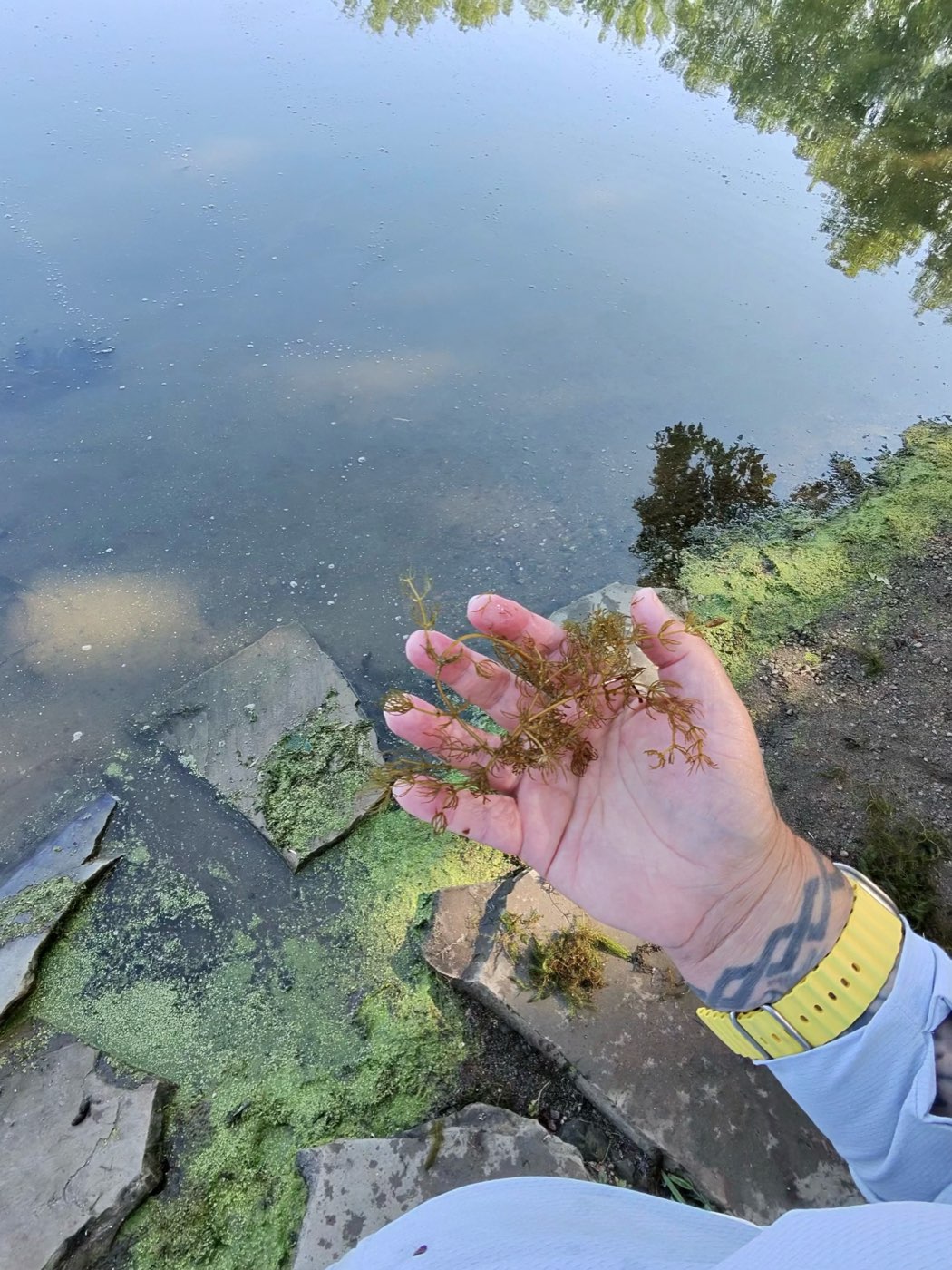
Milfoil. Finely divided, fern-like leaflets in whorls. The defining test is the leaflet arrangement: milfoil leaflets branch off a single central midline like a feather. Count the pairs - Eurasian watermilfoil carries 12 or more leaflet pairs per leaf, northern watermilfoil runs 5-10. Eurasian goes limp and collapses against the stem the moment it leaves the water; northern stays rigid and splays outward. Eurasian is smooth pulled through your hand.
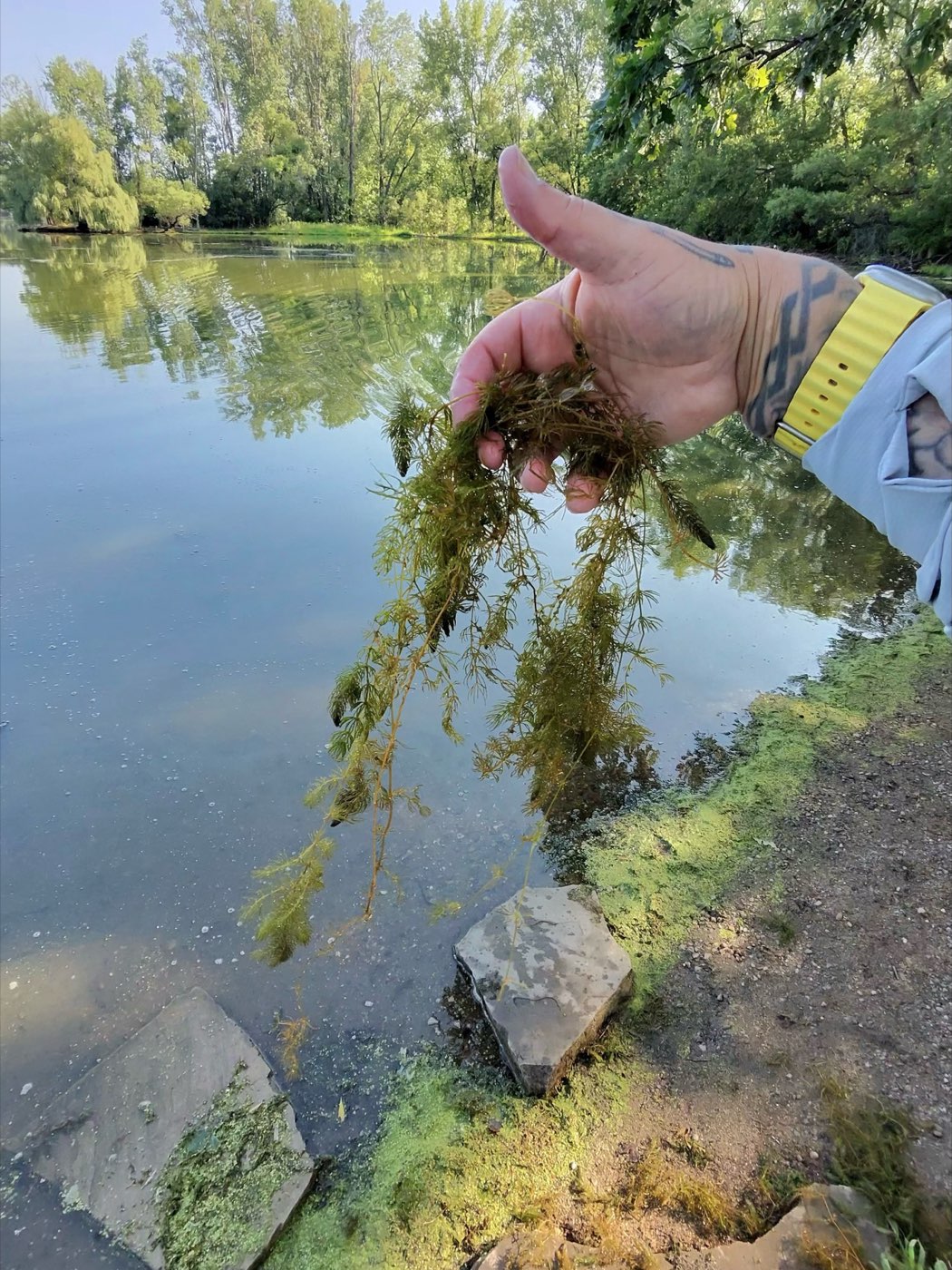
Coontail (hornwort). Bushy and forked rather than feathery, rough or spiny to the touch, thickening toward the tips like a bottle brush. The distinguishing test against milfoil: coontail leaflets fork off each other rather than branching from a single midline. Coontail has no true root system - it anchors loosely or drifts free - and it holds its shape out of water instead of going limp.
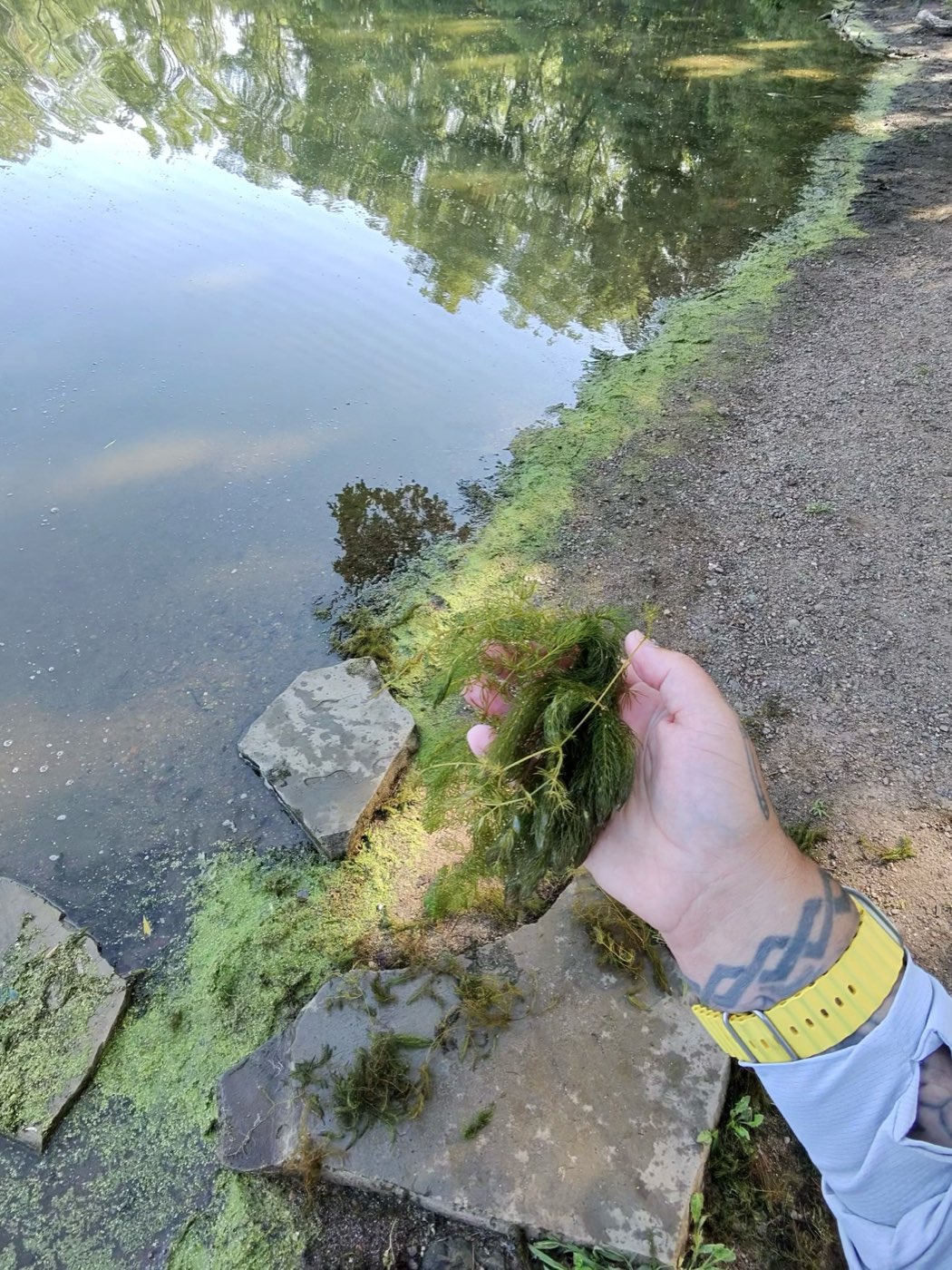
Naiad (bushy pondweed). Narrow leaves attached along a branching stem, opposite or in small whorls at each node, bunched densest toward the tips, often with tiny spines along the leaf margins. This is the one most often misidentified as wild celery.
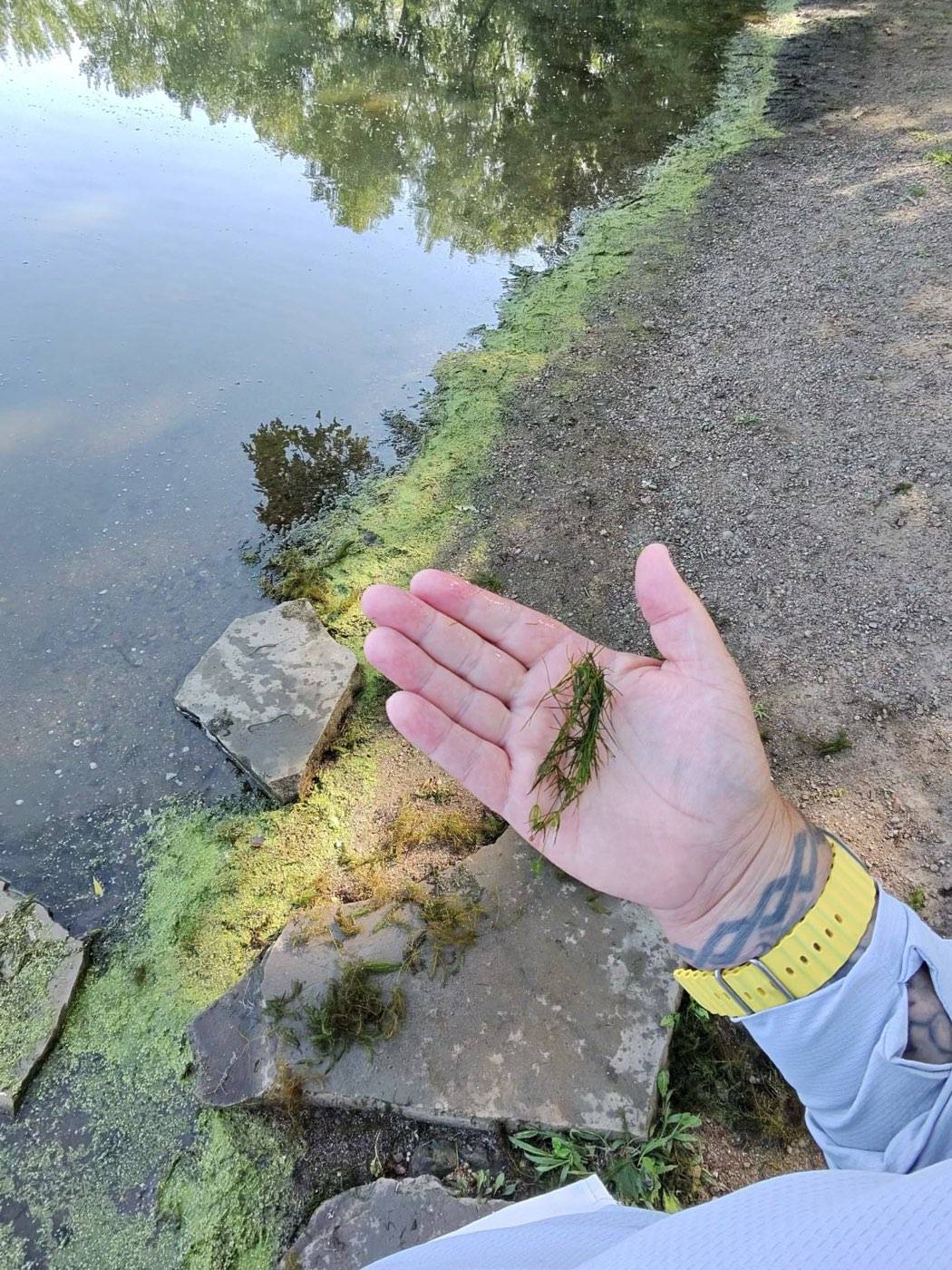
Wild celery (tape grass). The contrast that makes naiad obvious once you've seen it. Wild celery grows as unbranched ribbon blades rising from a basal rosette at the bottom, with a pale stripe down the center of each leaf and no leaves attached along a stem - because there is no leafy stem. If leaves are attached along a branching stem, it is not wild celery.
Narrow-leaf pondweeds such as sago add a fifth possibility: thread-fine leaves branching off a slender stem, often in a fan pattern, sometimes carrying small nut-like seed pods in mid-to-late summer. In practice these overlap enough with a discolored coontail sprig that a confident call from a photo isn't available.
Pro Tips
- Run the sample through a closed hand - smooth points to milfoil, rough or spiny points to coontail
- Watch what it does out of water - Eurasian milfoil collapses limp, coontail and northern milfoil stay rigid
- Check where leaves attach: along a branching stem means naiad or pondweed, from a basal rosette means wild celery
Important
- A species ID from a phone photo is a hypothesis, not a fact - confirm it in hand before building a pattern on it
- Coontail, bushy pondweed, and Chara are confused constantly even in the aquatic plant management literature
- Material wadded on your line during a retrieve is not a usable sample - it's compressed, mixed, and may contain several species
Filamentous Algae Is Not a Weed Bed
From ten feet away, a shoreline furred with filamentous algae looks like productive green water. It isn't the same thing as rooted vegetation, and treating them alike will cost you time.
How to tell them apart. Filamentous algae has no leaves, no stem, and no root structure - it's hair-like or cottony strands that mat together, coat rocks, and slough off in sheets. Pick some up and it falls apart between your fingers instead of holding a plant shape. Rooted vegetation has identifiable leaves attached to an identifiable stem.
Why it matters:
- No structure. Rooted plants build vertical habitat - stems, canopy, edges, pockets. Algae builds a film or a mat. There's no edge to patrol and no pocket to ambush from.
- Less forage. Rooted submersed vegetation supports substantially more invertebrate life than filamentous mats. Less invertebrate life means less baitfish, which means less reason for a bass to be there.
- Worse oxygen, not better. Heavy surface algae blocks atmospheric exchange, and overnight respiration on warm, still, cloudy nights can pull dissolved oxygen low enough to kill fish. A heavy bloom is a nutrient-load signal, not a habitat signal.
- It fouls everything. Strands wrap the line and hook point on nearly every cast, which quietly kills your presentation without you noticing.
The practical move is to fish the clean water, hard bottom, or rooted vegetation adjacent to it rather than the algae itself - and pick a bait profile that sheds strands.
Pro Tips
- If it falls apart in your hand with no visible stem or leaves, it's algae - move on
- Check your hook point every few casts in algae; a single wrapped strand blows the hookset
- Shorelines and shallow flats bloom first - the algae edge often marks where nutrient runoff enters
Where the Fish Actually Sit
The mental image of a bass sitting motionless inside a clump, waiting to ambush, is only half the picture. Anglers who have tracked individual fish with transmitters - John Hope's work is the most cited - report that bass move nearly constantly during active feeding periods, patrolling back and forth along cover edges and breaklines, and hold still mainly when inactive and resting.
Worth holding this more loosely than the oxygen data: it comes from angler-conducted tracking reported in the fishing press rather than controlled peer-reviewed study. But it's consistent with underwater observation, and it has a direct consequence. If you're parked on a spot getting repeated bites, you may not be catching one stationary fish over and over - you may be intercepting a school looping the same edge. That looks identical from the surface but implies a very different response: stay put and keep the presentation consistent rather than picking apart the cover.
The features worth your casts:
- The outside seam where vegetation meets open water, especially where it kinks around a point or dips into a pocket.
- Hard-bottom transitions - the base of riprap, a gravel-to-muck change, a ledge at the edge of the bed.
- Inside pockets and holes in the vegetation, which act like skylights and give bass a shaded rim to work.
- Isolated clumps away from the main growth - often the only cover in the neighborhood.
- Density changes - where sparse growth thickens or a bed thins out, regardless of what species it is.
Pro Tips
- Cast parallel to an edge rather than perpendicular - it keeps the bait in the strike zone for the whole retrieve
- From the bank, walk the shoreline and fan casts along the seam instead of firing straight out over the bed
- If a spot produces repeatedly, note the time - a patrolling school often comes back on a loop
Matching Presentation to Density
Identification and density reading only pay off if they change what you tie on. A working framework:
- Sparse, scattered growth (naiad, thin pondweed, isolated coontail sprigs): water moves through easily and light penetrates well. Moving baits shine - swim jigs, lipless cranks, spinnerbaits on a stop-start retrieve, fished through and around without constant fouling.
- Moderate cover along an edge: usually the highest-percentage zone. A jig or Texas-rigged worm worked parallel to the seam, with occasional casts into pockets, covers both edge-cruising fish and the ones tucked into cover.
- Dense stands and mats: fewer fish are buried deep inside than are sitting on top of, under, or right at the edge of the canopy. A weedless frog across the top, or a punched heavy Texas rig through thin spots - see Through the Thick of It for the full technique.
- Filamentous algae: not a target. Fish the clean water or rooted vegetation near it.
Species-specific adjustments. Coontail's rigid, bushy structure fouls treble hooks badly - go weedless or stay above it. Limp Eurasian milfoil collapses around a bait more than it snags it, so a swim jig can often be pulled through the top few inches. Naiad and thin pondweeds are sparse enough for open-hook presentations in many cases.
Let TackleLens match the specific rod, line, and lure to your conditions once you've identified what you're fishing.
Pro Tips
- Use the lightest presentation that stays clean - fouling is the hidden cost of over-gunning sparse cover
- Change baits when the plant changes, not when the lake changes - one shoreline can hold three species
A Checklist, Held Loosely
The through-line of this guide is that a pattern is only as good as the observation it rests on. Before you commit an afternoon to one:
- Confirm the plant in hand before building a pattern on it. Limp or rigid, forked or feather-midline, spiny or smooth, and where the leaves attach - ten seconds, and it prevents chasing the wrong signal.
- Fish edges and transitions first, not the visually thickest patch.
- Treat density as a dial, not a switch. Sparse and moderate cover often outperform the densest stands.
- Separate algae from rooted vegetation. They look alike at distance and mean opposite things.
- Re-verify patterns you've carried over from another lake, another plant species, or another point in the season.
- Ask what's actually driving a pattern that works. Cover type, edge geometry, forage, and light are usually tangled together, and isolating which one matters is the difference between something repeatable and a lucky afternoon.
Reading vegetation well is less about memorizing species than about noticing when you're guessing - and checking before the guess becomes a plan.
Important
- A pattern that worked on milfoil in June won't automatically transfer to coontail in August - re-verify the plant and the density
- Rinse and inspect gear between waters - milfoil and other invasives spread on fragments carried between lakes, and many states require it by law
Tags
Related Guides
Through the Thick of It
Punch through summer grass mats with a jig or Texas rig to reach the bass hiding from the sun. The science of why they're under there, and the technique to get them out.
Bass Seasonal Patterns
Understand how bass behavior changes throughout the year to consistently locate and catch fish.
Largemouth Bass Fishing
Master America's most popular gamefish with proven techniques for targeting largemouth bass in any season.