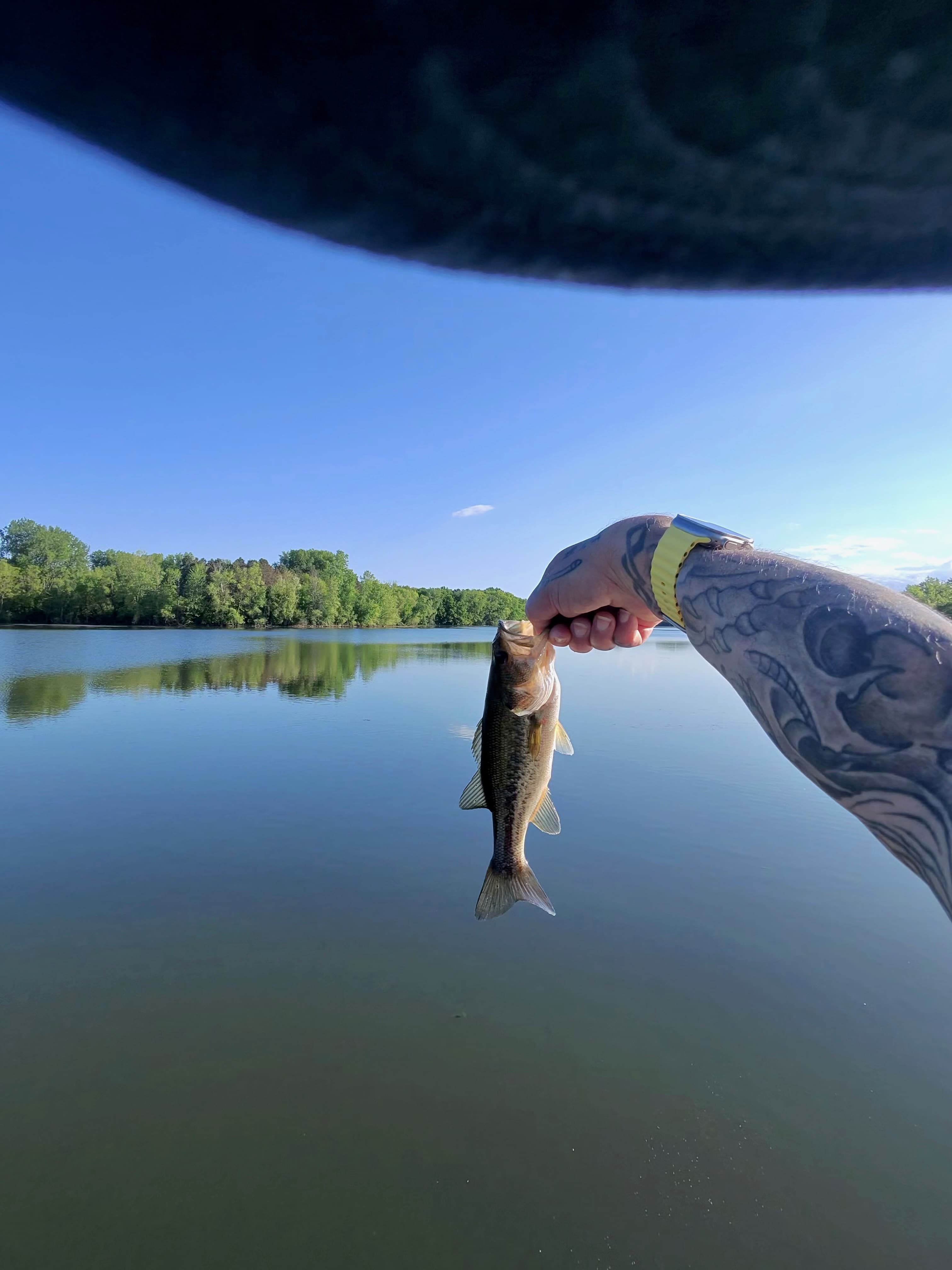
The drag screams. The rod loads to the cork. She comes up head-shaking, throws a wall of water, and dives again. Three more runs and she's finally on her side at the boat. You lip her, snap a photo, hold her up in the river current for a second, and she kicks off strong. Perfect release. Except an hour later, a hundred yards downstream, she's floating belly-up — and you never saw it.
Every angler knows the fight. Almost nobody knows what it costs the fish. The explosive power that makes a bass hit like a freight train and pull like it's twice its size runs on a specific piece of biochemistry — and that same machinery, pushed too far, is what kills fish after you think you've let them go. If you fish catch-and-release, this is the most important thing happening on your line that you can't see.
We've spent a lot of words on this blog teaching you how to get the bite. This one is about what happens after the hookset — and how to make sure the fish you release actually survives to be caught again.
The Engine Behind the Strike
A bass is built to ambush. It sits motionless, then explodes. That first surge — the strike, the head shake, the drag-burning run — comes almost entirely from white muscle, the pale meat that makes up the bulk of a bass's body. White muscle is built for one thing: maximum power, right now, with no waiting.
The catch is that "no waiting" means no oxygen. Powering that burst aerobically — the slow, efficient way your heart and your everyday muscles work — would take blood flow and time the fish doesn't have in a half-second ambush. So white muscle runs anaerobically. It burns stored fuel without oxygen, and that pathway dead-ends at a molecule called pyruvate. To keep the engine firing, the fish has to clear that pyruvate fast, and it does it with an enzyme called lactate dehydrogenase — LDH — which converts pyruvate into lactate. That single reaction is what lets the burst keep going. It's the turbocharger.
Here's the part that connects to the rod in your hand: bigger fish carry proportionally more of this machinery. Studies measuring LDH activity in bass have found that the enzyme's capacity in white muscle scales up with body size — a bigger fish isn't just a scaled-up small one, it's wired for a more violent burst. That's a real, measurable reason a five-pounder feels like it's going to rip the rod out of your hands while a dink just comes pinging in. The big one has a bigger turbo.
The Bill Comes Due
The turbocharger has a cost, and the fish pays it on credit. Every second of that fight, the anaerobic engine is dumping lactate into the muscle and then into the blood. As lactate builds, blood pH drops — the fish's internal chemistry literally turns acidic. Biologists call it lactic acidosis, and it's the same thing that makes a sprinter's legs seize at the end of a 400-meter race, except a fish can't choose to stop running.
The cruel twist is the timing. The acid load doesn't peak when the fish is fighting hardest. It peaks after — minutes to hours after you've released it, as lactate keeps flooding out of the exhausted muscle into the bloodstream. The fish that "kicked off strong" can be at its physiological worst long after it's out of sight. The fight was the easy part. Recovery is where fish actually die.
Why Warm Water Is the Multiplier
Temperature changes everything. Research on largemouth bass found that the amount of lactate built up during angling was directly proportional to two things: how long the fish was hooked, and how warm the water was. Longer fight, more acid. Warmer water, more acid. The two stack.
And warm water attacks from the other side at the same time. Warmer water holds less dissolved oxygen — exactly when the fish needs more of it to clear the acid and recover. So a long fight in 84°F water is a double hit: you've maxed out the acid load and gutted the fish's ability to bounce back from it. Recovery from that hyperlactic state can take around 24 hours even when the fish lives, and it's a window when the fish is sluggish, vulnerable, and a long way from "fine." A short fight in 60°F water is a different universe from the same fish, same fight, in August.
The Delayed-Mortality Trap
This is the part that fools good anglers. You watch the fish swim off under its own power, and you log it as a clean release. But delayed mortality — the fish that dies hours later from the acid load, exhaustion, or stress — doesn't show up in your boat. It shows up downstream, where you'll never count it.
A review pulling together more than a hundred catch-and-release studies put the average mortality across species and conditions at roughly 16% — and that number climbs sharply in warm water, after long fights, and with deep hooking. "Catch and release" is not the same as "no harm." It's a probability, and almost every variable that pushes it the wrong way is one you control with how you handle the fight.
Fighting and Landing So the Fish Lives
The science points at one overriding principle: get the fish in, get it back, minimize everything in between. That turns into a short, specific checklist.
- Don't under-gun your tackle. The romantic "light line, long fight" approach is the worst thing you can do to a fish you intend to release. Use line and a rod heavy enough to land the fish quickly. A 90-second fight is survivable; a ten-minute battle on 6-pound test is a death sentence in warm water.
- Keep it wet. A bass can't breathe in air, and air exposure is one of the biggest predictors of death. Keep the fish in the water while you unhook it. If you want a photo, have the camera ready first, then lift for ten to fifteen seconds, maximum. Count it out loud.
- Wet your hands. Dry hands and dry surfaces strip the protective slime coat that defends the fish against infection. Wet hands, wet mat, no carpet, no dry boat deck.
- Support the body. Lipping a bass vertically is fine for a small one, but support the belly of a heavy fish with your other hand. Hanging a big female by the jaw can damage her jaw and spine.
- Revive, don't toss. If the fish is exhausted, hold it upright in the water, facing into any current, until it grips and kicks off on its own. Don't rocket it back overboard from the deck. Let it tell you when it's ready.
- Tournament and livewell care. If you're holding fish, keep the livewell cool, aerated, and not overcrowded — and consider running ice and additives in summer. The same acid clock is ticking on every fish in that well.
None of this slows your day down in any way that matters. It's seconds per fish. The fish pays for those seconds in years.
The Warm-Water Decision
There's a harder call hiding in the data: sometimes the most ethical thing is not to fight the fish at all. When surface temperatures push into the 80s and oxygen bottoms out, even a well-handled bass is rolling loaded dice. In that window, fish the cool edges of the day — first light and last light — when water temps are lowest and the fish are feeding anyway. If you're fishing for the table that day, keep your limit early and stop; if you're releasing, recognize that midday August catch-and-release is the highest-mortality fishing you do all year.
This is exactly the kind of timing call SolunarBass is built for — lining up the sharpest feeding windows with the coolest, highest-oxygen parts of the day so you catch more fish in less time, and put less of the clock on each one. Fewer, faster, better-timed fights is better for your numbers and for the fishery.
Where This Science Actually Comes From
A quick, honest note, because we got here by way of an AI summary that called this "bass dehydrogenase" and credited a 1970s paper to a "researcher George Bass." Neither is real. There's no enzyme or field called "bass dehydrogenase" — it's just LDH, the single most-studied enzyme in fish, that happens to have been measured in fish that are named bass. And the "George Bass" attribution is a mix-up: the famous George F. Bass was a nautical archaeologist, while the actual biochemistry traces to researchers like George N. Somero, whose lab documented how LDH activity scales with body size in bass and other fishes.
The enzyme genetics genuinely are interesting in their own right: LDH exists in tissue-specific isozyme forms, and classic work by Whitt, Childers, and Wheat traced how those isozymes are inherited in interspecific bass (Micropterus) hybrids — part of how science untangled fish genetics decades before DNA sequencing was routine. It's real, and it's cool. It just has almost nothing to do with the fish on your line — which is why we built this piece around the part that does: the lactate clock you can actually fish around.
Further reading (the real sources):
- Physiological response of largemouth bass to angling stress (USGS) — lactate vs. hooking time and water temperature.
- A review of catch-and-release angling mortality (Bartholomew & Bohnsack) — the ~16% average and what drives it.
- LDH activity increases with body size in barred sand bass (The Biological Bulletin) — the enzyme-scaling finding.
Land Smarter, Release Better
You can't see the lactic-acid clock, but you can fish like it's running — because it is. Land fish fast, keep them wet, handle them in seconds, and back off when the water's too warm to release responsibly. The fishery you protect is the one you get to keep fishing.
The Bassfinity toolkit is built to put more of the day on your side of that equation. SolunarBass times your trips to the sharpest, coolest feeding windows. TackleLens dials in tackle that's strong enough to land fish quickly instead of grinding them down. BassLens AI helps you log and learn from every fish you catch. It all starts at the pricing page.
If you liked the biology angle, our match-the-hatch piece and our pre-spawn breakdown are cut from the same cloth — real fish science, turned into things you can actually do on the water.
Tight lines — and let the good ones swim.
— The Bassfinity Team